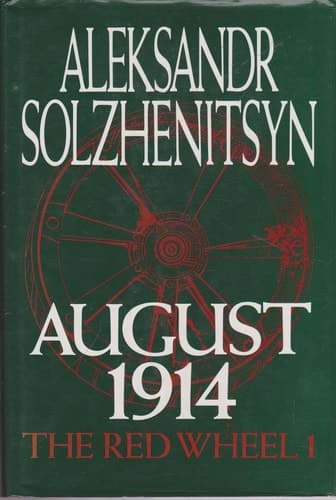
The Red Wheel A Narrative in Discrete Period of Time
Aleksandr Isaevich Solzhenit︠s︡ynPublished1989
Pages816
Formathardcover
PublisherBodley Head
Synopsis
In his monumental narrative of the outbreak of the First World War and the ill-fated Russian offensive into East Prussia, Solzhenitsyn has written what Nina Krushcheva, in The Nation, calls "a dramatically new interpretation of Russian history." The assassination of tsarist prime minister Pyotr Stolypin, a crucial event in the years leading up to the Revolution of 1917, is reconstructed from the alienating viewpoints of historical witnesses. The sole voice of reason among the advisers to Tsar Nikolai II, Stolypin died at the hands of the anarchist Mordko Bogrov, and with him perished Russia's last hope for reform. Translated by H.T. Willetts.
August 1914 is the first volume of Solzhenitsyn's epic, The Red Wheel; the second is November 1916. Each of the subsequent volumes will concentrate on another critical moment or "knot," in the history of the Revolution. Translated by H.T. Willetts.
Recommendations
Generating recommendations…
Our AI is preparing recommendations for The Red Wheel A Narrative in Discrete Period of Time. This usually takes under a minute.
About Aleksandr Isaevich Solzhenit︠s︡yn
A
Aleksandr Isaevich Solzhenit︠s︡yn
1918–2008
Aleksandr Solzhenitsyn was a Russian novelist, dramatist, and historian. Through his writings he helped to make the world aware of the Gulag, the Soviet Union's forced labor camp system – particularly The Gulag Archipelago and One Day in the Life of Ivan Denisovich, two of his two best-known works. Solzhenitsyn was awarded the Nobel Prize in Literature in 1970. He was exiled from the Soviet Union in 1974 and returned to Russia in 1994. Solzhenitsyn was the father of Ignat Solzhenitsyn, a conductor and pianist. ([Source][1].) [1]: https://en.wikipedia.org/wiki/Aleksandr_Solzhenitsyn
View author page