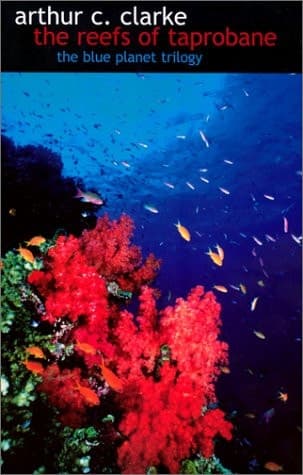
The Reefs of Taprobane Underwater Adventures Around Ceylon
Arthur C. ClarkePublished2002
Pages205
Formatpaperback
PublisherIbooks
Synopsis
Looking for new underwater worlds to conquer, Arthur Clarke and Mike Wilson followed up their expedition to Australia's Great Barrier Reef (described in The Coast of Coral) by exploring the romantic seas surrounding Ceylon. Meetings with dangerous and beautiful marine creatures were only one side of the expedition's activities. Their adventures included the discovery of many wrecks and the investigation of a 3,000-year-old Hindu temple lying on the ocean bed. Clarke and Wilson lived among the Ceylonese natives, their contact with Europeans virtually limited to the dozen members of the Ceylonese Reefcombers Club, who shared many of their underwater adventures. When weather conditions ruled out skin diving, they explored the awe-inspiring ruins of ancient Sinhalese cities, made trips into the jungles in search of wild life, and visited Buddhist monasteries. Clarke and Wilson's experiences provide vivid impressions of old and new Ceylon, one of the key countries of the Far East, and give vivid impressions of the fantastic life of the tropical reefs and the strange transformations which lost ships undergo when the sea works its will on them.
Recommendations
Generating recommendations…
Our AI is preparing recommendations for The Reefs of Taprobane Underwater Adventures Around Ceylon. This usually takes under a minute.
About Arthur C. Clarke
A
Arthur C. Clarke
1917–2008
Sir Arthur Charles Clarke CBE FRAS was a British science fiction writer, science writer and futurist, inventor, undersea explorer, and television series host. He is famous for being co-writer of the screenplay for the 1968 film 2001: A Space Odyssey, widely considered to be one of the most influential films of all time. Clarke was a science writer, who was both an avid populariser of space travel and a futurist of uncanny ability. On these subjects he wrote over a dozen books and many essays, which appeared in various popular magazines. In 1961 he was awarded the Kalinga Prize, an award which is given by UNESCO for popularising science. These along with his science fiction writings eventually earned him the moniker "Prophet of the Space Age". His other science fiction writings earned him a number of Hugo and Nebula awards, which along with a large readership made him one of the towering figures of science fiction. For many years Clarke, Robert Heinlein and Isaac Asimov were known as the "Big Three" of science fiction. Clarke was a lifelong proponent of space travel. In 1934, while still a teenager, he joined the British Interplanetary Society. In 1945, he proposed a satellite communication system using geostationary orbits. He was the chairman of the British Interplanetary Society from 1946–1947 and again in 1951–1953. Clarke emigrated from England to Sri Lanka (formerly Ceylon) in 1956, largely to pursue his interest in scuba diving. That year he discovered the underwater ruins of the ancient Koneswaram temple in Trincomalee. Clarke augmented his fame later on in the 1980s, from being the host of several television shows such as Arthur C. Clarke's Mysterious World. He lived in Sri Lanka until his death. Clarke was appointed Commander of the Order of the British Empire (CBE) in 1989 "for services to British cultural interests in Sri Lanka". He was knighted in 1998 and was awarded Sri Lanka's highest civil honour, Sri Lankabhimanya, in 2005. ---From Wikipedia
View author page