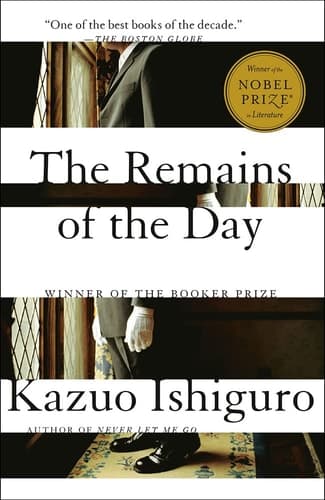
The Remains of the Day
Kazuo IshiguroPublished1990
Pages245
FormatSchool & Library Binding
PublisherTurtleback
Synopsis
The novel's narrator, Stevens, is a perfect English butler who tries to give his narrow existence form and meaning through the self-effacing, almost mystical practice of his profession. In a career that spans the second World War, Stevens is oblivious of the real life that goes on around him -- oblivious, for instance, of the fact that his aristocrat employer is a Nazi sympathizer. Still, there are even larger matters at stake in this heartbreaking, pitch-perfect novel -- namely, Stevens' own ability to allow some bit of life-affirming love into his tightly repressed existence.
Recommendations
Generating recommendations…
Our AI is preparing recommendations for The Remains of the Day. This usually takes under a minute.
About Kazuo Ishiguro
K
Kazuo Ishiguro
Born 1954
Sir Kazuo Ishiguro OBE FRSA FRSL (/kæˈzuːoʊ ˌɪʃɪˈɡʊəroʊ, ˈkæzuoʊ -/ kaz-OO-oh ISH-ig-OOR-oh, KAZ-oo-oh -; born 8 November 1954) is an English novelist, screenwriter, musician, and short-story writer. Ishiguro was born in Nagasaki, Japan, and moved to Britain in 1960 with his parents when he was five. He is one of the most critically-acclaimed and praised contemporary fiction authors writing in English, being awarded the 2017 Nobel Prize in Literature. In its 2017 citation, the Swedish Academy described Ishiguro as a writer "who, in novels of great emotional force, has uncovered the abyss beneath our illusory sense of connection with the world". [source](https://en.wikipedia.org/wiki/Kazuo_Ishiguro)
View author page