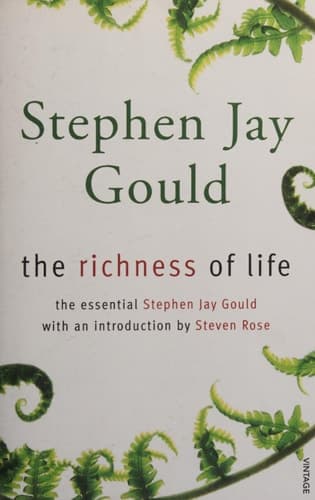
The Richness of Life The Essential Stephen Jay Gould
Stephen Jay GouldPublished2007
Pages656
Formatpaperback
PublisherVintage
Synopsis
"Nature is so wondrously complex and varied that almost anything possible does happen....I rejoice in its] multifariousness and leave the chimera of certainty to politicians and preachers."--from Ever Since Darwin
Upon his death in 2002, Stephen Jay Gould stood at the pinnacle among observers of the natural world, recognized by Congress as a "living legend." His prodigious legacy--sixteen best-selling and prize-winning books, dozens of scientific papers, an unbroken series of three hundred essays in Natural History--combined to make Gould the most widely read science writer of our time. This indispensable collection of forty-eight pieces from his brilliant oeuvre includes selections from classics such as Ever Since Darwin and The Mismeasure of Man, plus articles and speeches never before published in book form.
This volume, the last that will bear his name, spotlights his elegance, depth, and sheer pleasure in our world--a true celebration of an extraordinary mind.
Recommendations
The Selfish Gene
by Richard Dawkins
Dawkins shares Gould's gift for making complex scientific ideas luminous and accessible, but where Gould celebrated contingency and complexity, Dawkins builds elegant arguments from simple principles. You'll find the same intellectual rigor and pleasure in watching a mind work through difficult material, though they famously disagreed on evolution's mechanisms—reading both gives you the full conversation.
View book
Quilting and Braiding The Feminist Christologies of Sallie McFague and Elizabeth A. Johnson in Conversation
by Shannon Schrein
Kimmerer writes with Gould's sense of wonder about the natural world's strangeness and specificity, but she weaves in Indigenous perspectives that challenge Western scientific assumptions in ways that would have delighted Gould's pluralistic mind. It's part essay collection, part meditation—the structure mirrors Gould's own essay collections while offering a genuinely different lens on how we understand nature.
View book
The Struggle for Life A Companion to William James's The Varieties of Religious Experience
by Donald Capps
Here's your surprise pick: James was a psychologist and philosopher writing in 1902, but he shares Gould's conviction that human experience is irreducibly diverse and that neat categories fail to capture reality's messiness. Gould often wrote about how science gets distorted when we impose false certainties, and James does something similar for religion and consciousness—both men argue for intellectual humility in the face of genuine complexity.
View book
The Structure of Scientific Revolutions
by Thomas S. Kuhn
Kuhn's 1962 classic fundamentally shaped how Gould thought about science's history, and reading it after Gould gives you the intellectual foundation for understanding why Gould was so insistent that science isn't a linear march toward truth. Kuhn's prose is denser than Gould's, but the payoff is watching him dismantle the myth of inevitable scientific progress—a theme that runs through everything Gould wrote.
View book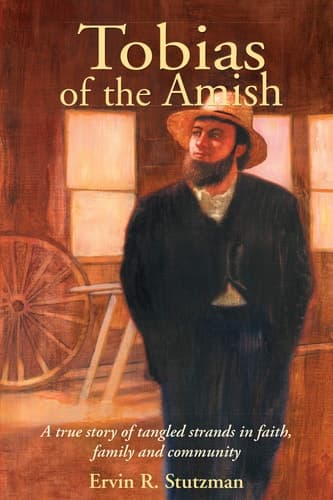
Tobias of the Amish A True Story of Tangled Strands in Faith, Family, and Community
by Unknown
Quammen writes natural history narrative the way Gould wrote essays—with narrative momentum, historical depth, and genuine intellectual drama. This book traces how molecular biology upended our understanding of life's relationships, revealing a messier, more interconnected tree than Darwin imagined. It's the kind of story Gould would have loved: science as an unfolding human adventure, not a predetermined march toward answers.
View bookAbout Stephen Jay Gould
Biography coming soon.
View author page