Synopsis
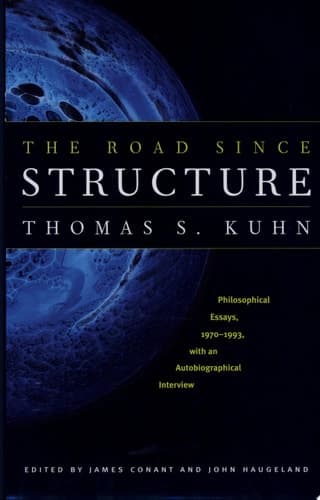
Divided into three parts, this is a record of the new direction the author was taking during the last two decades of his life. The first part of the book consists of essays in which he refines the basic concepts set forth in his novel Structure--paradigm shifts, incommensurability, and the nature of scientific progress. In the second part, he replies to many of the criticisms of his earlier work. And the third part of the volume is the transcript of a biographical interview with him conducted in Athens in 1995, not quite a year before his death. Here, the usually reticent author discusses his own intellectual development--his upbringing and thoughts about his education, the influence of his training as a physicist, his war work, his reelations with ihs colleagues, the responses to Structure--and his struggle to define his philosophical position before and after that work. (Midwest).
Recommendations

The Structure of Scientific Revolutions
by Thomas S. Kuhn
Wait—I know you just finished his later work, but if you haven't read the original 1962 *Structure* that sparked decades of debate, this is essential. Kuhn himself spends much of *The Road Since* wrestling with how his ideas were misread, so seeing the source material will let you understand exactly where the paradigm-shift concept came from and why philosophers have been arguing about it ever since.
View book
The Golem What Everyone Should Know about Science
by Harry M. Collins
Collins takes Kuhn's insights about how science actually works—not as a march toward objective truth, but as a human enterprise shaped by communities and consensus—and makes them tangible through case studies of real scientific disputes. Where Kuhn is abstract and reflective, Collins shows you the messiness in action, which gives you a different angle on the same fundamental questions about scientific authority.
View book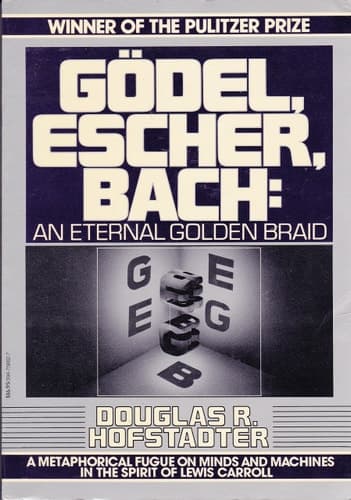
Gödel, Escher, Bach: An Eternal Golden Braid
by Douglas Hofstadter
This is the surprise pick, but hear me out: Hofstadter is obsessed with the same problem Kuhn kept circling—how do systems (mathematical, artistic, cognitive) shift from one level of organization to another? He explores it through music, visual art, and logic puzzles rather than scientific history, but the underlying question about incommensurability and how meaning emerges across different frameworks is remarkably similar. It's playful where Kuhn is austere, but the intellectual ambition is kindred.
View book
On the Shoulders of Giants: A Shandean Postscript
by Robert K. Merton
Merton was doing the sociology of science while Kuhn was doing the philosophy of it, and they were often in conversation (sometimes tension). This collection shows how Merton examined the social institutions and norms that shape scientific practice—the reward systems, the priority disputes, the role of secrecy and openness. It's a complementary lens on why science works the way it does, grounded in empirical observation rather than conceptual analysis.
View book
The Savage Mind
by Claude Lévi-Strauss
Lévi-Strauss argues that different cultures organize knowledge through fundamentally different conceptual structures—not because one is primitive and one advanced, but because they're incommensurable systems. Published in 1962 (the same year as *Structure*), it's asking a parallel question in anthropology: how do we compare ways of thinking that operate by different rules? You'll find echoes of Kuhn's framework applied to culture rather than science, which deepens both arguments.
View bookAbout Thomas S. Kuhn
T
Thomas S. Kuhn
1922–1996
American historian, physicist and philosopher
View author page