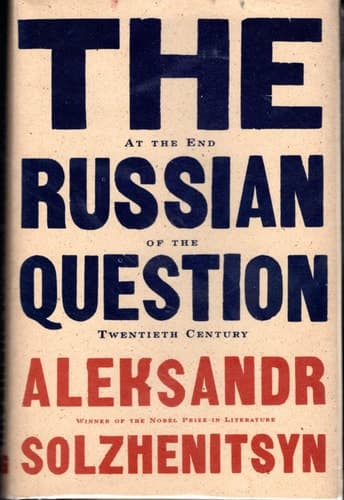
The Russian Question At the End of the Twentieth Century
Aleksandr Isaevich Solzhenit︠s︡ynPublished1995
Pages135
Formathardcover
PublisherFarrar, Straus and Giroux
Synopsis
On the occasion of his return to the country from which he was expelled twenty years ago, Russia's greatest living writer gives us a succinct and impassioned impression of his beliefs and hopes for his homeland. Beginning with an overview of the last five hundred years of Russian history, Aleksandr Solzhenitsyn highlights his country's accomplishments and mistakes, analyzing the disaster of the Soviet years and painting a brutally vivid picture of the current state of affairs. Although he sees Russia in moral, economic, and social disarray, he also sees the possibility of a way out for a new generation who, with a renewed understanding of their history, can surmount the obstacles of the day and create a just and independent society - a Russian future. Provocative, spirited, and timely, The Russian Question speaks not only to Russians, whose destiny Solzhenitsyn has returned to share, but also to the Western world that received him in exile, awarded him a Nobel Prize in Literature, and made him one of the most widely read writers of our time.
Recommendations
Generating recommendations…
Our AI is preparing recommendations for The Russian Question At the End of the Twentieth Century. This usually takes under a minute.
About Aleksandr Isaevich Solzhenit︠s︡yn
A
Aleksandr Isaevich Solzhenit︠s︡yn
1918–2008
Aleksandr Solzhenitsyn was a Russian novelist, dramatist, and historian. Through his writings he helped to make the world aware of the Gulag, the Soviet Union's forced labor camp system – particularly The Gulag Archipelago and One Day in the Life of Ivan Denisovich, two of his two best-known works. Solzhenitsyn was awarded the Nobel Prize in Literature in 1970. He was exiled from the Soviet Union in 1974 and returned to Russia in 1994. Solzhenitsyn was the father of Ignat Solzhenitsyn, a conductor and pianist. ([Source][1].) [1]: https://en.wikipedia.org/wiki/Aleksandr_Solzhenitsyn
View author page