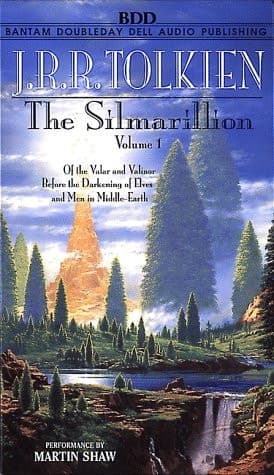
Synopsis
The Silmarillion tells of the Elder Days, of the First Age of Tolkien's World, when Morgoth, the first Dark Lord, dwelt in Middle Earth, and the High Elves made war upon them for the recovery of the Silmarils, the jewels containing the pure light of Valinor. It is to this ancient drama that the characters in The Lord of the Rings so often look back to.
Before the world began, the startling beauty of the Holy Ones awakened into song. The sound, like countless choirs, became an ever-changing melody. It was the music of the Ainur that set the world spinning within the endless habitation of space. Music filled the earth with air and fire and water; stone and silver and gold; vast halls and spaces. And Music it was that caused the Children of Invatar, Men and Elves, to be born.
Of the Elven races, it was the Noldor, the most skilled of Elves in Earthlore, who first achieved the power of making gems. And it was the great Elf FÙanor who made the Silmarils, the fairest of all gems, long since lost. Kept within the Silmarils was the glory of the light of the Two Trees of Valinor, long after the Trees themselves were poisoned by the greed of the first Dark Lord Morgoth. These three great living jewels were hallowed so no mortal flesh nor anything evil might touch them. But deep within His fortress underground, the Dark Lord lusted after them. The peaceful days of Valinor were numbered, and despite the revolt of the Elves, the Dark Lord triumphed. As was His wish, Elves and Men became estranged. Those of the Elven race waned and faded and men usurped the sunlight....
The Silmarillion, considered to be Tolkien's most important work, is the story of the creation of the world and the happenings of the First Age, clearly setting the stage for all his other works. With a superb performance by Martin Shaw, this first installment of three volumes will thrill and delight Tolkien fans of all ages, and listeners will treasure this extraordinary presentation for years to come.
Recommendations

The Name of the Wind
by Patrick Rothfuss
Like The Silmarillion, this novel is deeply concerned with how stories become legend and how the truth gets buried under layers of myth—except Rothfuss tells it from the perspective of the legendary figure himself, unreliably recounting his own past. You'll get that same sense of a vast, intricate world with its own history and magic system, but experienced through a more intimate, character-driven lens.
View book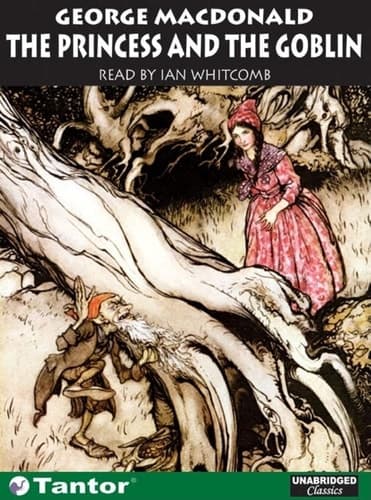
The Princess and the Goblin
by George MacDonald
This might seem like a departure—it's quieter and more introspective than The Silmarillion's grand conflicts—but it shares that same meticulous attention to genealogy, court politics, and the weight of inherited duty that runs through Tolkien's work. Addison builds her world through protocol and naming conventions the way Tolkien does through etymology, and there's real tenderness in watching an outsider navigate a complex magical society.
View book
Solar Labyrinth Exploring Gene Wolfe's Book of the New Sun
by Robert Borski
Wolfe constructs his dying Earth with the same archaeological layering you find in The Silmarillion—ancient civilizations, forgotten technologies, names that carry historical weight—but he makes you work for understanding in ways that are almost Talmudic. The prose is denser and more challenging, but if you loved untangling Tolkien's First Age chronology, you'll find Wolfe's puzzle-box narrative deeply rewarding.
View book![Cover of Giovanni Ba[t]tista Piranesi The Prisons (le Carceri)](/_next/image?url=https%3A%2F%2Fcovers.whatshouldireadnext.com%2Feditions%2F9780486215402%2Flg.jpg&w=3840&q=75)
Giovanni Ba[t]tista Piranesi The Prisons (le Carceri)
by Giambattista Piranesi
Clarke does something remarkable here: she takes the fragmentary, mythological storytelling mode of The Silmarillion and compresses it into a slim, haunting novel about memory and identity. The way she reveals her world's true nature mirrors how Tolkien gradually unfolds the cosmology of Middle-earth, but through a single character's dawning realization rather than an omniscient narrator.
View book
Toni Morrison - Beloved
by Carl Plasa
This is the surprise pick, but hear me out: Morrison uses the supernatural and ancestral haunting the way Tolkien uses his First Age—as a way to explore how the past refuses to stay buried and shapes the present with inexorable weight. Both authors treat their mythic/historical material with absolute seriousness, and both understand that trauma and beauty are inseparable. The prose has that same incantatory, almost liturgical quality as The Silmarillion.
View bookAbout J.R.R. Tolkien
J
J.R.R. Tolkien
1892–1973
John Ronald Reuel Tolkien (1892-1973) was a major scholar of the English language, specialising in Old and Middle English. Twice Professor of Anglo-Saxon (Old English) at the University of Oxford, he also wrote a number of stories, including most famously The Hobbit (1937) and The Lord of the Rings (1954-1955), which are set in a pre-historic era in an invented version of the world which he called by the Middle English name of Middle-earth. This was peopled by Men (and women), Elves, Dwarves, Trolls, Orcs (or Goblins) and of course Hobbits. He has regularly been condemned by the Eng. Lit. establishment, with honourable exceptions, but loved by literally millions of readers worldwide. In the 1960s he was taken up by many members of the nascent "counter-culture" largely because of his concern with environmental issues. In 1997 he came top of three British polls, organised respectively by Channel 4 / Waterstone's, the Folio Society, and SFX, the UK's leading science fiction media magazine, amongst discerning readers asked to vote for the greatest book of the 20th century. ([Source][1]) [1]: http://www.tolkiensociety.org/tolkien/biography.html
View author page