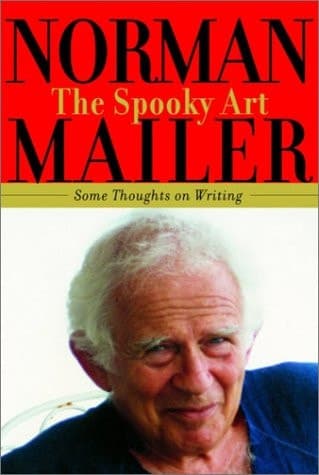
The Spooky Art: Some Thoughts on Writing
Norman MailerPublished2003
Pages330
Formathardcover
PublisherRandom House
Synopsis
“Writing is spooky. There is no routine of an office to keep you going, only the blank page each
morning, and you never know where your words are coming from, those divine words.”
In The Spooky Art, Norman Mailer discusses with signature candor the rewards and trials of the writing life, and recommends the tools to navigate it. Addressing the reader in a conversational tone, he draws on the best of more than fifty years of his own criticism, advice, and detailed observations about the writer’s craft. Mailer explores, among other topics, the use of first person versus third person, the pressing need for discipline, the pitfalls of early success, and the dire matter of coping with bad reviews. While The Spooky Art offers a fascinating preview of what can lie in wait for the student and fledgling writer, the book also has a great deal to say to more advanced writers on the contrary demands of plot and character, the demon writer’s block, and the curious ins-and-outs of publishing. Throughout, Mailer ties in examples from his own career, and reflects on the works of his fellow writers, living and dead—Twain, Melville, Faulkner, Hemingway, Updike, Didion, Bellow, Styron, Beckett, and a host of others. In The Spooky Art, Mailer captures the unique untold suffering and exhilaration of the novelist’s daily life and, while plotting a clear path for other writers to follow, maintains reverence for the underlying mystery and power of the art.
Recommendations
Generating recommendations…
Our AI is preparing recommendations for The Spooky Art: Some Thoughts on Writing. This usually takes under a minute.
About Norman Mailer
N
Norman Mailer
1923–2007
Norman Kingsley Mailer was an American novelist, journalist, essayist, poet, playwright, screenwriter and film director. Along with Truman Capote, Joan Didion, Hunter S. Thompson, John McPhee, and Tom Wolfe, Mailer is considered an innovator of narrative nonfiction, a genre sometimes called New Journalism, which superimposes the essay onto the nonfiction novel. He was awarded the Pulitzer Prize twice and the National Book Award once. In 1955, Mailer, together with Ed Fancher and Dan Wolf, first published The Village Voice, which began as an arts and politics oriented weekly newspaper distributed in Greenwich Village. In 2005, he won the Medal for Distinguished Contribution to American Letters from the National Book Foundation. ([Source][1]) [1]: http://en.wikipedia.org/wiki/Norman_Mailer
View author page