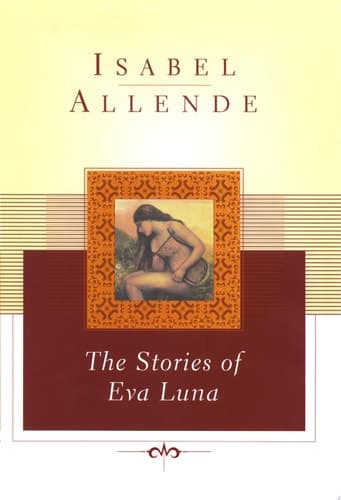
The Stories of Eva Luna
Isabel AllendePublished1999
Pages330
Formathardcover
PublisherSimon and Schuster
Synopsis
Isabel Allende now ranks as one of the world's most beloved authors. In 1988, she introduced the world to Eva Luna, in a novel of the same name that recounted the adventurous life of a poor young Latin American woman who finds friendship, love, and some measure of worldly success through her powers as a storyteller. Her most ambitious novel up to that time, "Eva Luna" was described by the "Washington Post" as "a cascade of stories [that] tumbles out before the reader, stories vivid, passionate and human." Returning to this tale by popular demand, Allende unveiled "The Stories of Eva Luna" in 1991. A treasure trove of brilliantly crafted tales, the book showed us once again why "Eva Luna" and her much-celebrated creator have won such a large and devoted readership.We begin with Rolf Carle, the European refugee, journalist, and lover who figured so largely in "Eva Luna." Lying in bed with Eva Luna, he asks her to tell him a story. "What about?" she asks. "Tell me a story you have never told anyone before. Make it up for me." And so she does, giving Rolf Carle and the reader twenty-three vibrant, enchanting demonstrations of her artistry. Here are "compesinos" and rich people, guerrillas and fortune-tellers, great beauties and tyrants, the foreign rendered indelibly familiar. Here is Clarisa, "born before the city had electricity, she lived to see television coverage of the first astronaut levitating on the moon, and she died of amazement when the Pope came for a visit and was met in the street by homosexuals dressed up as nuns"; here is El Capitan, who waited for forty years before proposing to his dancing partner; Horacio Fortunato, a circus owner and entrepreneur, whose encounterwith a languid foreign woman will force him to change his roguish ways even as he attempts to court her; Maurizia Rugieri, who abandons her husband and child for a young medical student, converting their life together into an opera of her own design; Nicholas Vidal, who "had always known that a woman would cost him his life" but never suspected that it would be the wife of Judge Hidalgo; Raid Halbi, once again displaying his concern and wisdom for the people of Agua Santa; Marcia Liberman, the wife of a European diplomat, whose brief affair with the President for Life of an unnamed Latin American country has startling rewards...Love, vengeance, nostalgia, compassion, irony -- Isabel Allende leaves no emotion untouched in these stories. Opulently imagined, stirringly told, they confirm her place as one of the world's leading writers.
Recommendations
Generating recommendations…
Our AI is preparing recommendations for The Stories of Eva Luna. This usually takes under a minute.
About Isabel Allende
I
Isabel Allende
Born 1942
Isabel Angélica Allende Llona (Lima, Perú; 2 de agosto de 1942) es una escritora chilena con nacionalidad estadounidense, de ascendencia hispano-portuguesa y nacida en Perú. Desde 2004 es miembro de la Academia Estadounidense de las Artes y las Letras. Obtuvo el Premio Nacional de Literatura de su país en 2010. La venta total de sus libros alcanza 73 millones de ejemplares y sus obras han sido traducidas a 42 idiomas. Es considerada como la escritora viva más leída del mundo de la lengua española. Sobrina y ahijada del expresidente chileno Salvador Allende (1970 - 1973), comenzó su carrera literaria como periodista. Tras el la muerte de su tío en el golpe militar de Chile en 1973 y el derrocamiento del gobierno de coalición, Isabel Allende abandonó Chile y se refugió en Venezuela. Su primera novela, *La casa de los espíritus* (1985), que surgió directamente de su exilio, se convirtió en un éxito de ventas y crítica mundial. A menudo entreteje elementos de mito y realismo, o lo que se conoce como "realismo mágico". Sus novelas a veces se basan en su propia infancia y experiencias vitales. ---------- Isabel Allende was born on 2 August 2 1942 in Lima, Peru. The niece and goddaughter of Salvador Allende, the former president of Chile from 1970 to 1973, she started her writing career as a journalist. Several months after her uncle's assassination and the overthrow of Chile's coalition government in 1973, Allende left Chile and found refuge in Venezuela. Her first novel, The House of the Spirits (1985), which arose directly out of her exile, became a worldwide bestseller and critical success. She often weaves together elements of myth and realism, or what is known as "magic realist." Her novels are sometimes based on her own childhood and life experiences. Allende has been called "the world's most widely read Spanish-language author."
View author page