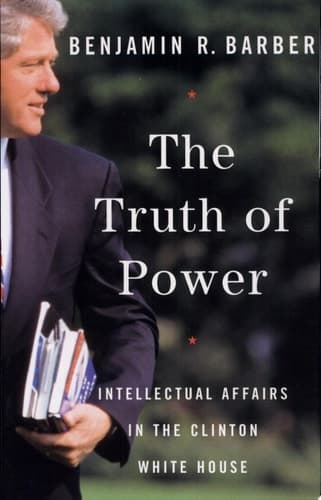
The Truth of Power Intellectual Affairs in the Clinton White House
Benjamin R. BarberPublished2001
Pages320
Formathardcover
PublisherW. W. Norton & Company
Synopsis
President Clinton had a romance with big ideas. He intently cultivated intellectuals, seducing them with his characteristic charm and with the promise of real influence on the political stage. Yet most often he disappointed the big thinkers whose advice he sought.
Benjamin Barber was first invited to Camp David in 1994, along with other prominent members of the academic community, to participate in a seminar with President Clinton on the future of Democratic ideas and ideals. Afterwards, he became a steady informal adviser to the White House. For a politically committed professor like Barber, the opportunity was exhilarating--here was an opportunity to put ideas into action, to link ideas to power. The result was enlightening, if unexpected. The most unpredictable factor was the president himself: a man of astonishing intellectual gifts, a consummate listener and synthesizer of ideas, who nonetheless failed to present a stirring progressive vision or even to craft a memorable speech.
With great perceptiveness, wit, and élan, Barber provides a startling meditation on truth and power--and the truth of power, which is the responsibility of the elected not to an idea but to the electorate. He identifies the fault lines that future progressive candidates must straddle if they are to win--and the gift they must have, if they are to be great, of calling forth the best in their fellow citizens. In the end, Barber give us a unique portrait of our compelling and maddening ex-president, and the hopes and disillusionments he represents.
Recommendations
Generating recommendations…
Our AI is preparing recommendations for The Truth of Power Intellectual Affairs in the Clinton White House. This usually takes under a minute.
About Benjamin R. Barber
B
Benjamin R. Barber
1939–2017
Benjamin R. Barber (August 2, 1939 – April 24, 2017) was an American political theorist and author, perhaps best known for his 1995 bestseller, *Jihad vs. McWorld*, and for 2013's *If Mayors Ruled the World* as well as the classic of democratic theory, 1984's *Strong Democracy* (revised in 2004). He became a top-level international consultant on participatory democracy as well as an adviser to Bill Clinton and Howard Dean. **Source**: <a href="https://en.wikipedia.org/wiki/Benjamin_Barber">Benjamin Barber</a> on Wikipedia (Wikipedia contributors, <a href="https://en.wikipedia.org/wiki/Wikipedia:Text_of_Creative_Commons_Attribution-ShareAlike_3.0_Unported_License">CC BY-SA 3.0</a>).
View author page