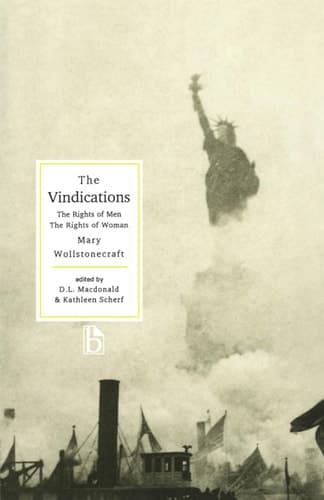
The Vindications: The Rights of Men and The Rights of Woman
Mary WollstonecraftPublished1997
Pages488
Formatpaperback
PublisherBroadview Press
Synopsis
The works of Mary Wollstonecraft (1759-1797) ranged from the early Thoughts on the Education of Daughters to The Female Reader, a selection of texts for girls, and included two novels. But her reputation is founded on A Vindication of the Rights of Woman of 1792. This treatise is the first great document of feminism—and is now accepted as a core text in western tradition.
It is not widely known that the germ of Wollstonecraft’s great work came out of an earlier and much shorter vindication—A Vindication of the Rights of Men (1790), written in the context of the issues raised by the French Revolution. This edition, which follows the model of other Broadview Editions in including a range of materials that help the reader to see the work in the context of its era out of which it emerged, is arranged chronologically, opening with Wollstonecraft’s “other vindication.” It also includes a wide range of other documents in appendices, as well as a comprehensive and authoritative introduction, chronology, and full index.
Recommendations
Generating recommendations…
Our AI is preparing recommendations for The Vindications: The Rights of Men and The Rights of Woman. This usually takes under a minute.
About Mary Wollstonecraft
M
Mary Wollstonecraft
1759–1797
Mary Wollstonecraft (pronounced /ˈwʊlstən.krɑːft/; 27 April 1759 – 10 September 1797) was an eighteenth-century British writer, philosopher, and advocate of women's rights. During her brief career, she wrote novels, treatises, a travel narrative, a history of the French Revolution, a conduct book, and a children's book. Wollstonecraft is best known for *A Vindication of the Rights of Woman* (1792), in which she argues that women are not naturally inferior to men, but appear to be only because they lack education. She suggests that both men and women should be treated as rational beings and imagines a social order founded on reason.
View author page