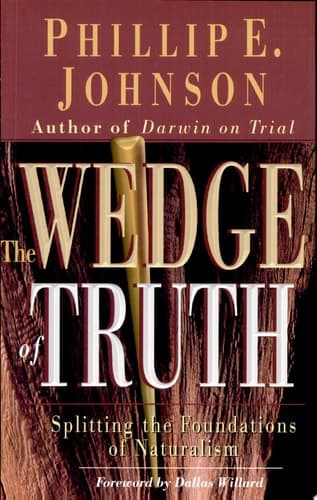
The Wedge of Truth Splitting the Foundations of Naturalism
Phillip E. JohnsonPublished2002
Pages192
Formatpaperback
PublisherInterVarsity Press
Synopsis
• A 2001 ECPA Gold Medallion Award winner
• A 2001 Christianity Today Award of Merit winner
Science is the supreme authority in our culture.
If there is a dispute, science arbitrates it. If a law is to be passed, science must ratify it. If truth is to be taught, science must approve it. And when science is ignored, stroms of protest are heard in the media, in the university--even in local coffee shops.
Yet a society ruled by science (and the naturalistic philosophy that undergirds much of it) faces major problems. Science speaks so authoritatively in our culture that many are tempted to use its clout to back claims that go beyond the available evidence. How can we spot when such ideological slight of hand has taken place?
More important, while we may learn a great deal from science, it does not offer us unlimited knowledge. In fact, most scientists readily acknowledge that science cannot provide answers to questions of ultimate purpose or meaning. So to what authority will we turn for these?
The deficiencies in science and the philosophy (naturalism) that undergirds it call for a cognitive revolution--a fundamental change in our thinking habits. And it all begins with a wedge of truth.
This wedge of truth does not "wedge out" a necessary foundation of rational thought. But it does "wedge in" the much-needed acknowledgment that reason encompasses more than mere scientific investigation. Phillip E. Johnson argues compellingly for an understanding of reason that brings scientific certainty back into relational balance with philosophical inquiry and religious faith.
Applying his wedge of truth, Johnson analyzes the latest debates between science and religion played out in our media, our universities and society-at-large. He looks to thinkers such as Newbigin, Polanyi and Pascal to lay a foundation for our seeing the universe in a totally different way. And from that base he then considers the educational programs and research agendas that should be undertaken--and have already begun in some earnest--during this new century.
In the end, Johnson prophetically concludes that the walls of naturalism will fall and that the Christian gospel must play a vital role in building a new foundation fro thinking--not just about science and religion but about everyhting that gives human life hopeand meaning.
Recommendations
The Soul of Science Christian Faith and Natural Philosophy
by Nancy Pearcey
Pearcey picks up exactly where Johnson leaves off—she's not just critiquing naturalism's limitations, but actively reconstructing how Christians can engage with scientific inquiry without surrendering either faith or intellectual rigor. Where Johnson lays the philosophical groundwork, Pearcey shows you how to actually live and think within that framework, with concrete examples from biology, physics, and medicine that make the abstract debate suddenly practical.
View book
The Abolition of Man, Or, Reflections on Education with Special Reference to the Teaching of English in the Upper Forms of Schools
by Clive Staples Lewis
Published in 1943, this slim volume predates Johnson's work by decades but speaks to the same crisis—Lewis diagnoses how modern thought has systematically stripped meaning and objective value from human reasoning itself. Johnson's 'wedge of truth' is essentially Lewis's answer to what happens when we lose the transcendent anchors for knowledge; reading Lewis first (or now) gives you the historical depth to see how prescient Johnson's concerns actually were.
View book
The Structure of Scientific Revolutions
by Thomas S. Kuhn
Here's the surprise move: Kuhn's landmark work on how science actually progresses (through paradigm shifts, not linear accumulation) is the intellectual foundation that Johnson builds on—but Kuhn himself wasn't writing Christian apologetics. Reading Kuhn directly lets you see how even secular philosophy of science undermines the 'science as ultimate authority' narrative Johnson critiques, and you'll spot where Johnson draws his ammunition. It's the opposing player's playbook, and it's essential.
View book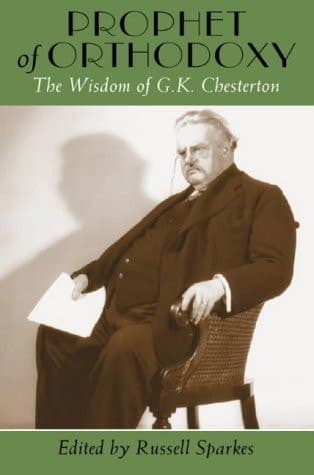
Prophet of Orthodoxy The Wisdom of G.K. Chesterton
by Gilbert Keith Chesterton
Chesterton writes with a wit and imaginative force that makes Johnson's arguments feel like they're dancing—he's defending Christian faith and reason against modern skepticism, but he does it by showing how Christianity is actually the most rational, coherent, and joyful worldview available. If Johnson's wedge of truth feels like a logical argument you need to accept, Chesterton makes you *want* to accept it because he shows you how beautiful and sensible it is.
View bookAbout Phillip E. Johnson
P
Phillip E. Johnson
Born 1940
Biography coming soon.
View author page