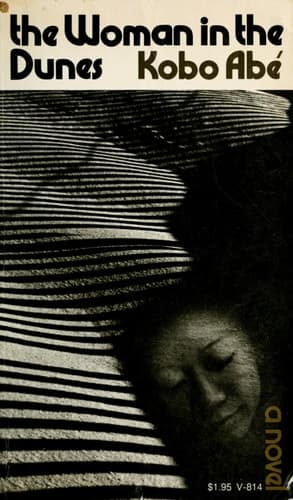
Synopsis
Text: English, Japanese (translation)
Recommendations
Franz Kafka's the Castle (Bloom's Modern Critical Interpretations)
by Unknown
Like Abe's protagonist trapped in an absurd situation with no clear rules, K. finds himself caught in bureaucratic quicksand where the logic of the system becomes increasingly surreal the harder he tries to understand it. Both novels use physical entrapment as a mirror for existential confusion—the sand pit and the castle are less about geography than about the impossibility of grasping one's own circumstances.
View book
The Savage Detectives A Novel
by Roberto Bolaño
Bolaño shares Abe's fascination with how meaning dissolves under scrutiny—here, a group of poets chase literary mystery through Mexico City in a narrative that fragments and spirals much like the sand pit's inescapable logic. Both authors trust readers to sit with discomfort and ambiguity rather than offering resolution, and both examine how obsession can become its own kind of trap.
View book
Invisible Cities
by Italo Calvino
A surprise recommendation, but hear me out: where Abe uses one location to interrogate reality itself, Calvino uses fifty imaginary cities to do the same thing. Both are formally inventive works that feel like philosophical thought experiments disguised as stories—you'll recognize that same quality of watching a mind work through a problem rather than following a conventional plot.
View book
The remains of the day de Kazuo Ishiguro
by Gallix/François
Ishiguro, like Abe, excels at showing how people rationalize their own imprisonment—Stevens's loyalty to his employer mirrors the sand-pit protagonist's gradual acceptance of his fate. Both novels are quiet, controlled, and devastating precisely because the characters' self-deception is so methodical and understandable; you watch someone construct their own cage brick by brick.
View book
The Hearing Trumpet
by Leonora Carrington
Published in 1974, this surrealist novella shares Abe's interest in how reality becomes unstable when you examine it closely—but Carrington approaches it with dark humor and magical absurdity rather than existential dread. An elderly woman in a nursing home discovers her world is far stranger than it appears, and like Abe, Carrington uses a confined setting to explore the gap between what we're told is real and what actually is.
View bookAbout Kōbō Abe
K
Kōbō Abe
1924–1993
Kōbō Abe (安部 公房) is the pseudonym of Kimifusa Abe (安部 公房). Abe was born in Kita, Tokyo, the son of a physician who taught medicine. He was raised in Mukden, Manchuria. He returned to Japan in 1941, and in 1943 he went to Tokyo Imperial University, where he earned a medical degree but he failed his medical exam and was forbidden from practicing. He returned to Manchuria as an author. In 1947, he self-published his first book, Mumei-shishū ("Poems of an unknown poet"). His wrote avant-garde poetry, novels, and plays. In 1977 he was elected a Foreign Honorary Member of the American Academy of Arts and Sciences.
View author page