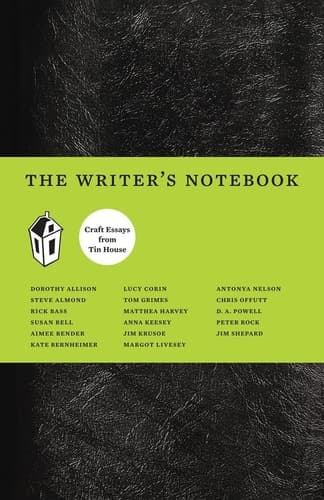
The Writer's Notebook: Craft Essays from Tin House
Dorothy AllisonPublished2009
Pages288
Formatpaperback
PublisherTin House Books
Synopsis
The Writer's Notebook offers aspiring authors the most enlightening and engaging seminars and essays from some of Tin House's favorite writers. Jim Shepard, Aimee Bender, Steve Almond, Antonya Nelson and others break down specific elements of craft and share insights into the joys and pains of their own writing. The Writer's Notebook: Craft Essays from Tin House combines the best craft seminars in the history of the Tin House Summer Writers Workshop with a variety of essays written by some of Tin House's favorite authors, offering aspiring writers insight into the craft of writing. Dorothy Allison, Jim Shepard, Aimee Bender, Steve Almond, D. A. Powell, and others break down elements of craft and share insights into the joys and pains of their own writing. This cast of deeply respected poets and prose writers explore topics that vary from writing dialogue to the dos and don'ts of writing about sex. With how-tos, close readings, and personal anecdotes,The Writer's Notebook offers future scribes advice and inspiration.
Recommendations
Bird by Bird Some Instructions on Writing and Life
by Anne Lamott
Lamott does what The Writer's Notebook does—breaks down the messy, unglamorous reality of writing—but through a memoir lens that's deeply personal and often hilarious. Where Tin House's essays are craft-focused seminars, Lamott writes like she's sitting across from you at coffee, admitting her own failures and neuroses while teaching you how to actually finish something.
View book
The Savage Detectives A Novel
by Roberto Bolaño
This is the surprise pick: it's a novel, not an essay collection, but it's fundamentally *about* writers and the writing life in a way that mirrors what you just read. Bolaño structures his narrative like a series of overlapping craft lessons—showing rather than telling how dialogue works, how to build character through voice, how to sustain tension across hundreds of pages. It's experimental enough to feel like a masterclass disguised as fiction.
View book
The Situation and the Story The Art of Personal Narrative
by Vivian Gornick
Gornick takes the essay-craft approach but zeroes in specifically on memoir and personal narrative—the territory where Allison herself does her best work. She's rigorous about the difference between what happened and what it *means*, which is exactly the kind of granular craft thinking you found valuable in The Writer's Notebook, but applied to one genre with surgical precision.
View book
Wonderboy and the Black Hole of Nixvy Veck
by TERRY L. MIRLL
VanderMeer combines the workshop-essay format you just enjoyed with something more visually engaging—illustrations, diagrams, and examples that make abstract craft concepts concrete. He covers the same territory as Tin House (dialogue, character, structure) but with a particular emphasis on how genre conventions can actually *enable* rather than constrain creativity, which feels like a natural next step in your craft education.
View book
The Ode Less Travelled: Unlocking the Poet Within
by Stephen Fry
Here's a book from 2011 that does something the Tin House collection hints at but doesn't fully explore: it examines the blurry space between poetry and prose, between lyric and narrative. Burt writes with the same generous, demystifying tone as your recent read, but he's specifically interested in how contemporary writers are breaking the rules you've just learned—which is often where the most interesting work happens.
View bookAbout Dorothy Allison
D
Dorothy Allison
1949–2024
Biography coming soon.
View author page