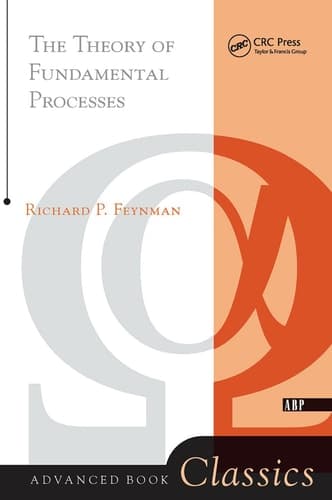
Theory Of Fundamental Processes
Richard P. FeynmanPublished1998
Pages192
Formatpaperback
PublisherAvalon Publishing
Synopsis
In these classic lectures, Richard Feynman first considers the basic ideas of quantum mechanics, treating the concept of amplitude in special detail and emphasizing that other things, such as the combination laws of angular momenta, are largely consequences of this concept. Feynman also discusses relativity and the idea of anti-particles, finally returning to a discussion of quantum electrodynamics, which takes up most of this volume.
Recommendations
Generating recommendations…
Our AI is preparing recommendations for Theory Of Fundamental Processes. This usually takes under a minute.
About Richard P. Feynman
R
Richard P. Feynman
1918–1988
Richard Phillips Feynman was an American theoretical physicist known for his work in the path integral formulation of quantum mechanics, the theory of quantum electrodynamics, and the physics of the superfluidity of supercooled liquid helium, as well as in particle physics for which he proposed the parton model. For his contributions to the development of quantum electrodynamics, Feynman, jointly with Julian Schwinger and Sin-Itiro Tomonaga, received the Nobel Prize in Physics in 1965. - Wikipedia
View author page