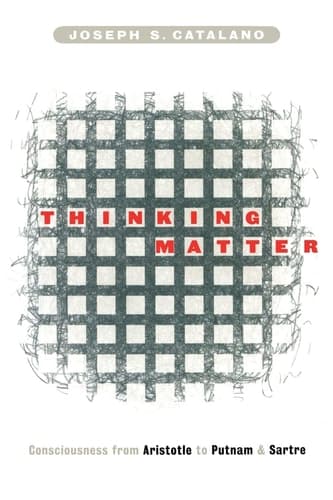
Thinking Matter Consciousness from Aristotle to Putnam and Sartre
Joseph S. CatalanoPublished2000
Pages224
Formatpaperback
PublisherRoutledge
Synopsis
First published in 2000. Routledge is an imprint of Taylor & Francis, an informa company.
Recommendations

Stop Eating Junk! in 5 Minutes a Day for 21 Days Let Your Unconscious Mind Do the Work
by Steve Murray
Chalmers picks up exactly where Catalano's historical survey leaves off, wrestling with the 'hard problem' of consciousness that Putnam and others gestured toward but couldn't quite solve. You'll recognize the philosophical lineage immediately, but Chalmers brings contemporary neuroscience into the conversation in ways that make the abstract debates suddenly urgent and concrete.
View book
Being and Nothingness: An Essay on Phenomenological Ontology
by Jean-Paul Sartre
Since Catalano devotes significant attention to Sartre's existentialism, this is the primary text itself—but it's worth reading as a deep dive rather than a summary. Sartre's prose is notoriously dense, but having Catalano's framework in your head means you'll catch the architecture beneath the difficulty, and you'll see how his ideas about consciousness and freedom actually work in practice, not just in theory.
View book
Gödel, Escher, Bach An Eternal Golden Braid
by Douglas R. Hofstadter
Here's your surprise pick: Hofstadter approaches consciousness through pattern, recursion, and self-reference rather than pure philosophy, but he's asking the same questions Catalano traces through Aristotle to Putnam. The book reads like a conversation between a mathematician, an artist, and a musician, and it'll make you think about consciousness as something that *emerges* from complexity rather than something to be located in matter or mind.
View book
The Structure of Scientific Revolutions
by Thomas S. Kuhn
Published in 1962, this gives you that historical perspective from a different era. Kuhn's argument about paradigm shifts directly illuminates *why* the conversation about consciousness and matter kept changing shape across the centuries Catalano covers—each philosopher wasn't just wrong, they were working within incompatible frameworks. It's a meta-lens that makes the whole history more intelligible.
View book
Hegel's Preface to the Phenomenology of Spirit
by Georg Wilhelm Friedrich Hegel
Catalano references Hegel throughout but doesn't let him dominate—reading Hegel directly will show you how consciousness-as-process became central to European thought, and why both Sartre and later analytic philosophers had to reckon with his ideas about self-awareness and negation. Fair warning: it's genuinely difficult, but you've got the conceptual scaffolding from Catalano to climb it.
View bookAbout Joseph S. Catalano
Biography coming soon.
View author page