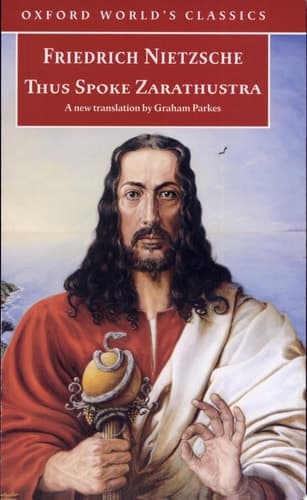
Thus Spoke Zarathustra A Book for Everyone and Nobody
Friedrich Wilhelm NietzschePublished2005
Pages335
Formatpaperback
PublisherOxford University Press
Synopsis
hus Spake Zarathustra is a masterpiece of literature as well as philosophy. It was Nietzsche's own favorite and has proved to be his most popular. In this book he addresses the problem of how to live a fulfilling life in a world without meaning, in the aftermath of "the death of God." His solution lies in the idea of eternal recurrence, which he calls "the highest formula of affirmation that can ever be attained." A successful engagement with this profoundly Dionysian idea enables us to choose clearly among the myriad possibilities that existence offers, and thereby to affirm every moment of our lives with others on this "sacred" earth.
Grahm Parkes's new translation is more accurate than previous versions, and is the first to retain the musicality of the original, by paying attention to the rhythms and cadences of the German. His introduction examines the work's three most important philosophical ideas and for the first time annotates the abundance of allusions to the Bible and other classic texts with which Nietzsche's masterpiece is in conversation.
Recommendations
Generating recommendations…
Our AI is preparing recommendations for Thus Spoke Zarathustra A Book for Everyone and Nobody. This usually takes under a minute.
About Friedrich Wilhelm Nietzsche
F
Friedrich Wilhelm Nietzsche
1917–1979
Giorgio Colli (1917 – 6 January 1979) was an Italian philosopher, philologist and historian. A native of Turin, taught ancient philosophy at Pisa's university for thirty years; he edited and translated Aristotle's *Organon and Kant's Critique of Pure Reason* for Einaudi, a major publishing house in Italy. Subsequently, he produced the first complete edition of Nietzsche's work (including all the posthumous fragments chronologically ordered) together with his friend Mazzino Montinari. His work culminated in *La Sapienza greca*, an edition and translation of the "Presocratics" (a term he rejected). Interrupted by his death in January 1979, it was supposed to be in eleven volumes. **Source**: [Giorgio Colli](https://en.wikipedia.org/wiki/Giorgio_Colli) on Wikipedia.
View author page