Synopsis
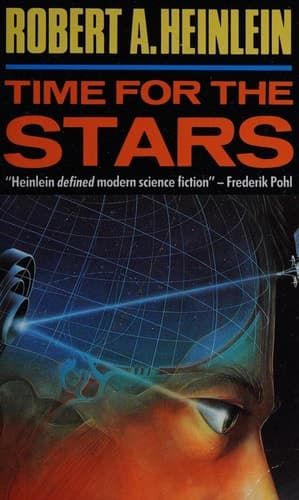
Time for the Stars (Heinlein's Juvenile series, Bk 10) With over-population stretching the resources of Earth, the need to find and colonize other Terra-type planets is becoming crucial to the survival of the human race. Travel to other planets is a reality but time-consuming and costly. The scientists at the Long Range Foundation create the remarkable Torchships. With no time to wait years for communication between slower-than-light spaceships and home, the Long Range Foundation explores an unlikely solution...human telepathy. Tom and Pat are recruited by LRF to become the human transmitters and receivers for the mission. Growing up together they had felt like they were so similar, so in sync, that it was almost as if they read each other's minds. Only to discover, that was indeed what they could do. Along with other telepathic pairings, their abilities are tested, and it is discovered that time nor distance impedes their connection; communication between Earth and the Torchships would be instantaneous. But there is a catch: during the course of the mission, while one of them stays behind and grows old, on Earth, the other will be traversing the stars, and, if he survives, will return a young man.
Time for the Stars is a science fiction novel by Robert A. Heinlein first published by Scribner's in 1956 as one of the Heinlein juveniles. The basic plot line is derived from a 1911 thought experiment in special relativity, commonly called the twin paradox, proposed by French physicist Paul Langevin. "The word that comes to mind for Heinlein is essential. As a writer, eloquent, impassioned, technically innovative, he reshaped science fiction in the way that defined it for every writer who followed him. He was the most significant science fiction writer since H. G. Wells." Robert Silverberg
Recommendations
Generating recommendations…
Our AI is preparing recommendations for Time for the Stars. This usually takes under a minute.
About Robert Anson Heinlein
Robert Anson Heinlein was an American science fiction writer. Often called "the dean of science fiction writers", he was one of the most popular, influential, and controversial authors of the genre. He set a high standard for science and engineering plausibility and helped to raise the genre's standards of literary quality. He was one of the first writers to break into mainstream, general magazines such as The Saturday Evening Post, in the late 1940s, with unvarnished science fiction. He was among the first authors of bestselling, novel-length science fiction in the modern, mass-market era. For many years, Heinlein, Isaac Asimov, and Arthur C. Clarke were known as the "Big Three" of science fiction. ([Source](http://en.wikipedia.org/wiki/Robert_A._Heinlein).)
View author page