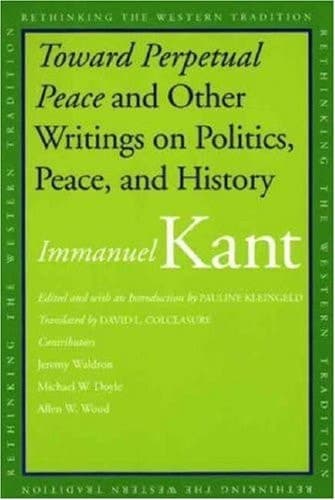
Toward Perpetual Peace and Other Writings on Politics, Peace, and History (Rethinking the Western Tradition)
Immanuel KantPublished2006
Pages265
Formatpaperback
PublisherYale University Press
Synopsis
Immanuel Kant’s views on politics, peace, and history have lost none of their relevance since their publication more than two centuries ago. This volume contains a comprehensive collection of Kant’s writings on international relations theory and political philosophy, superbly translated and accompanied by stimulating essays.
Pauline Kleingeld provides a lucid introduction to the main themes of the volume, and three essays by distinguished contributors follow: Jeremy Waldron on Kant’s theory of the state; Michael W. Doyle on the implications of Kant’s political theory for his theory of international relations; and Allen W. Wood on Kant’s philosophical approach to history and its current relevance.
Recommendations
Generating recommendations…
Our AI is preparing recommendations for Toward Perpetual Peace and Other Writings on Politics, Peace, and History (Rethinking the Western Tradition). This usually takes under a minute.
About Immanuel Kant
I
Immanuel Kant
1724–1804
Immanuel Kant was an 18th-century German philosopher from the Prussian city of Königsberg. Kant was the last influential philosopher of modern Europe in the classic sequence of the theory of knowledge during the Enlightenment beginning with thinkers John Locke, George Berkeley, and David Hume. Kant created a new perspective in philosophy which had widespread influences on philosophy continuing through to the 21st century. He published important works on epistemology, as well as works relevant to religion, law, and history. One of his most prominent works is the *Critique of Pure Reason*, an investigation into the limitations and structure of reason itself. It encompasses an attack on traditional metaphysics and epistemology, and highlights Kant's own contribution to these areas. The other main works of his maturity are the *Critique of Practical Reason*, which concentrates on ethics, and the *Critique of Judgment*, which investigates aesthetics and teleology. <sup>[1][1]</sup> [1]: https://en.wikipedia.org/wiki/Immanuel_Kant
View author page