
Toward the Poetics of Surrealism
J. H. MatthewsPublished1976
Pages241
Formathardcover
PublisherSyracuse Univ Pr
Synopsis
Dust jacket, in removable mylar, has some foxing to edges. 6 1/2" x 9 1/4". Text body is clean, and free from previous owner annotation, underlining and highlighting. Binding is tight, covers and spine fully intact. NOT ex-library. Shipped Under 1 kilogram. Literature & Literary; 0815601204. ISBN/ 9780815601203. Inventory 022470.
Recommendations
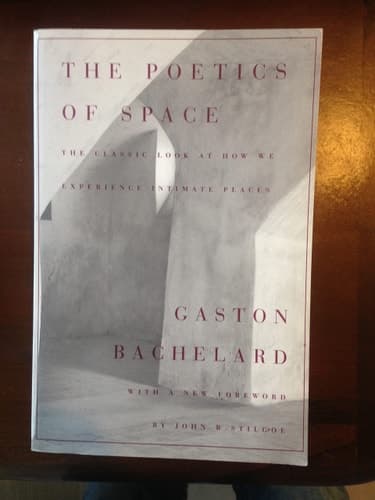
The Poetics of Space
by Gaston Bachelard
Since you've engaged with Matthews' theoretical framework for understanding surrealism, Bachelard offers a complementary phenomenological approach to how spaces and objects generate meaning in our imagination. Both texts treat poetry not as decoration but as a fundamental way of knowing—Bachelard just approaches it through domestic architecture and intimate spaces rather than surrealist movements.
View book
André Breton, Nadja
by Roger Navarri
This is the surrealist manifesto-as-narrative that Matthews likely references throughout his poetics—a text that *performs* surrealism rather than merely describing it. Reading Breton's actual prose after studying Matthews' analysis gives you the delightful experience of recognizing the techniques you've just learned about in action, like watching a magic trick after learning how it's done.
View book
If on a Winter's Night a Traveler Introduction by Peter Washington
by Italo Calvino
Calvino's metafictional playfulness shares surrealism's interest in disrupting conventional narrative logic, but he approaches it through postmodern games rather than the unconscious. Where Matthews examines how surrealists fractured meaning, Calvino shows what happens when you make the reader complicit in that fracturing—it's surrealism's mischievous cousin.
View book
The Savage Detectives A Novel
by Roberto Bolaño
Here's your surprise recommendation: this sprawling 1998 novel reads like a surrealist fever dream disguised as a literary mystery, with Matthews' theoretical concerns about meaning-making embedded in the actual narrative structure. Bolaño captures that same surrealist impulse to find significance in the marginal and overlooked, but through the lens of late-20th-century Latin American literature rather than early modernism.
View book
Simone de Beauvoir's the Second Sex
by George Myerson
De Beauvoir's philosophical investigation into how meaning gets constructed around gender shares Matthews' interest in how cultural systems shape perception and imagination. Published in 1949, it bridges the surrealist era Matthews studies with postwar existentialism, and her rigorous analysis of how women are positioned as 'Other' parallels surrealism's interest in disrupting fixed meanings.
View bookAbout J. H. Matthews
Biography coming soon.
View author page