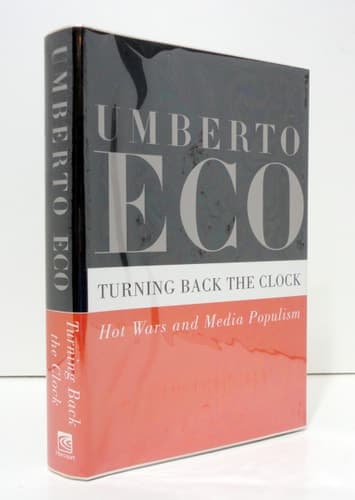
Turning Back the Clock Hot Wars and Media Populism
Umberto EcoPublished2007
Pages369
Formathardcover
PublisherHoughton Mifflin Harcourt
Synopsis
The time: 2000 to 2005, the years of neoconservatism, terrorism, the twenty-four-hour news cycle, the ascension of Bush, Blair, and Berlusconi, and the invasions of Afghanistan and Iraq. Umberto Eco's response is a provocative, passionate, and witty series of essays--which originally appeared in the Italian newspapers La Repubblica and L'Espresso--that leaves no slogan unexamined, no innovation unexposed. What led us into this age of hot wars and media populism, and how was it sold to us as progress? Eco discusses such topics as racism, mythology, the European Union, rhetoric, the Middle East, technology, September 11, medieval Latin, television ads, globalization, Harry Potter, anti-Semitism, logic, the Tower of Babel, intelligent design, Italian street demonstrations, fundamentalism, The Da Vinci Code, and magic and magical thinking.The famous author and respected scholar shows his practical, engaged side: an intellectual involved in events both local and global, a man concerned about taste, politics, education, ethics, and where our troubled world is headed.
Recommendations
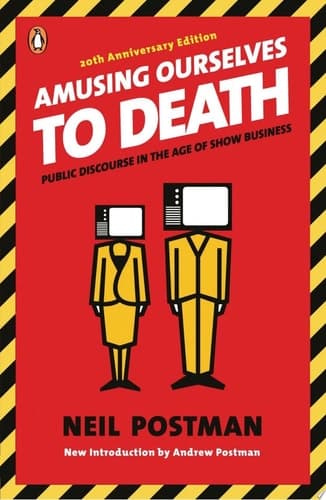
Amusing Ourselves to Death Public Discourse in the Age of Show Business
by Neil Postman
Postman dissects how television has fundamentally altered our relationship with truth and discourse—he's doing in 1985 what Eco does in these essays, but with laser focus on one medium. You'll recognize Eco's concerns about media manipulation echoed here, except Postman predicted most of it before the Iraq War even happened, which makes his argument feel almost prophetic when read alongside Eco's real-time analysis.
View book
The Apocalyptic Vision of Mikhail Bulgakov's the Master and Margarita (Studies in Slavic Language & Literature)
by Edward E. Ericson
This 1967 Soviet novel uses magical realism and satire to dismantle propaganda and state mythology—it's Eco's intellectual playfulness applied to narrative form rather than essays. Like Eco examining how slogans obscure reality, Bulgakov shows how official narratives collapse when confronted with actual human complexity and the absurd, all wrapped in a darkly comic plot that keeps you genuinely unsure what's real.
View book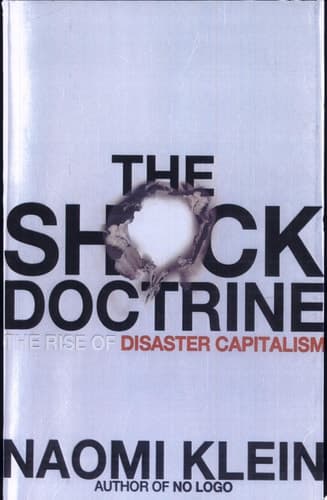
The Shock Doctrine The Rise of Disaster Capitalism
by Naomi Klein
Klein traces how disaster capitalism and neoconservative ideology were weaponized globally—she's essentially writing the economic and political history that contextualizes Eco's 2000-2005 observations about Bush, Blair, and globalization. Where Eco critiques the rhetoric and mythology, Klein shows you the actual machinery and profit motives behind the policies, making them uncomfortable partners in understanding the same era.
View book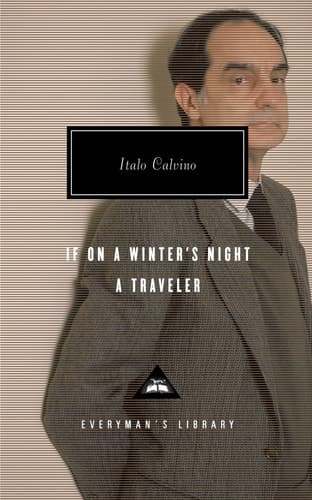
If on a Winter's Night a Traveler Introduction by Peter Washington
by Italo Calvino
Calvino's metafictional novel does formally what Eco does intellectually—it plays with narrative structures, reader expectations, and the nature of meaning-making itself. Both writers share that Italian sensibility of treating serious ideas (here: how we construct meaning from texts) with playful irreverence, and Calvino's recursive, digressive style mirrors Eco's essay collection's ability to jump from Harry Potter to medieval Latin without missing a beat.
View book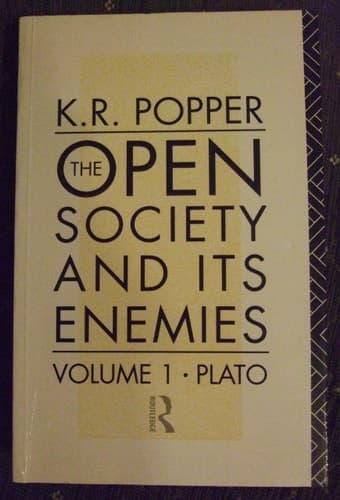
The Open Society and Its Enemies
by Karl Raimund Popper
Popper's 1945 philosophical critique of totalitarianism and closed systems of thought provides the intellectual scaffolding for understanding why Eco is so concerned with fundamentalism, magical thinking, and the rhetoric that enables authoritarianism. It's denser and more systematic than Eco's essays, but reading it after Eco gives you the theoretical foundation for why his scattered observations about racism, intelligent design, and populism all point toward the same danger: the seduction of certainty.
View bookAbout Umberto Eco
U
Umberto Eco
1932–2016
Umberto Eco (5 January 1932 – 19 February 2016) was an Italian novelist, literary critic, philosopher, semiotician, and university professor. He is widely known for his 1980 novel Il nome della rosa (The Name of the Rose), a historical mystery combining semiotics in fiction with biblical analysis, medieval studies, and literary theory. He later wrote other novels, including Il pendolo di Foucault (Foucault's Pendulum) and L'isola del giorno prima (The Island of the Day Before). His novel Il cimitero di Praga (The Prague Cemetery), released in 2010, topped the bestseller charts in Italy. Eco also wrote academic texts, children's books, and essays, and edited and translated into Italian books from French, such as Raymond Queneau’s “Exercises in Style” (1983). He was the founder of the Department of Media Studies at the University of the Republic of San Marino,[3] president of the Graduate School for the Study of the Humanities at the University of Bologna, member of the Accademia dei Lincei, and an honorary fellow of Kellogg College, Oxford.
View author page