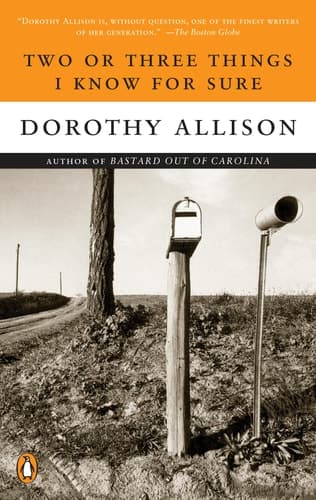
Two or Three Things I Know for Sure
Dorothy AllisonPublished1996
Pages112
Formatpaperback
PublisherNational Geographic Books
Synopsis
Bastard Out of Carolina, nominated for the 1992 National Book Award for fiction, introduced Dorothy Allison as one of the most passionate and gifted writers of her generation. Now, in Two or Three Things I Know for Sure, she takes a probing look at her family's history to give us a lyrical, complex memoir that explores how the gossip of one generation can become legends for the next.
Illustrated with photographs from the author's personal collection, Two or Three Things I Know for Sure tells the story of the Gibson women -- sisters, cousins, daughters, and aunts -- and the men who loved them, often abused them, and, nonetheless, shared their destinies. With luminous clarity, Allison explores how desire surprises and what power feels like to a young girl as she confronts abuse.
As always, Dorothy Allison is provocative, confrontational, and brutally honest. Two or Three Things I Know for Sure, steeped in the hard-won wisdom of experience, expresses the strength of her unique vision with beauty and eloquence.
Recommendations

Safe at Last in the Middle Years The Invention of the Midlife Progress Novel : Saul Bellow, Margart Drabble, Anne Tyler, and John Updike
by Margaret Morganroth Gullette
Like Allison, Ernaux uses her own family's story as a lens to examine how personal shame and class intersect across generations, but she does it through a radical collective voice that shifts between 'I' and 'we.' Where Allison photographs the Gibson women, Ernaux photographs French society itself through the intimate details of her family's rise and fall—same unflinching honesty about desire and bodies, but filtered through a completely different cultural moment.
View book
Blues and Roots/Rue and Bluets A Garland for the Southern Appalachians
by Jonathan Williams
This is my surprise pick for you—it's technically a lyric essay about color and heartbreak, not a traditional memoir, but Nelson does what Allison does with photographs: she fragments and reassembles fragments (numbered sections, color theory, personal confession) to make meaning from pain. It's shorter and more experimental than what you just read, but that same willingness to be 'provocative and confrontational' about desire and vulnerability runs through every page.
View book
The Book of Margery Kempe A New Translation, Contexts, Criticism
by Barry Windeatt
I'm reaching back to 1436 here because Kempe's medieval autobiography has that same raw, almost embarrassing honesty about female desire, family dysfunction, and spiritual searching that Allison brings to the 20th century. Both women refuse to be palatable; both write themselves as complicated, sometimes unlikeable, always truthful. The distance in time actually makes the parallel more striking—these concerns aren't new, and Allison knew that.
View book
Berryman and Lowell The Art of Losing
by Stephen Matterson
Zeniter traces three generations of an Algerian family across displacement, immigration, and silence—the way Allison traces the Gibson women across poverty and abuse. But where Allison works through photographs and direct memory, Zeniter uses the gaps and silences, the things her grandmother won't say, as the actual subject. Both writers understand that family history isn't just what happened; it's what gets told, what gets hidden, and how those stories shape who we become.
View bookAbout Dorothy Allison
D
Dorothy Allison
1949–2024
Biography coming soon.
View author page