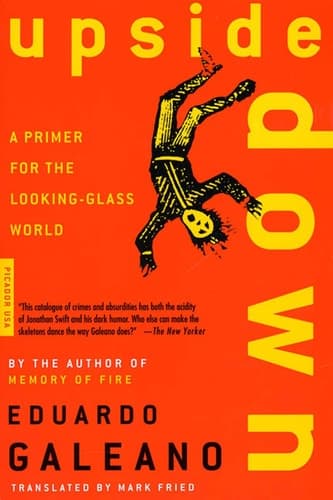
Upside Down A Primer for the Looking-Glass World
Eduardo GaleanoPublished2001
Pages368
Formatpaperback
PublisherPicador
Synopsis
In a series of mock lesson plans and a "program of study" Galeano provides an eloquent, passionate, funny and shocking exposé of First World privileges and assumptions. From a master class in "The Impunity of Power" to a seminar on "The Sacred Car"—with tips along the way on "How to Resist Useless Vices" and a declaration of the "The Right to Rave"—he surveys a world unevenly divided between abundance and deprivation, carnival and torture, power and helplessness.
We have accepted a "reality" we should reject, he writes, one where poverty kills, people are hungry, machines are more precious than humans, and children work from dark to dark. In the North, we are fed on a diet of artificial need and all made the same by things we own; the South is the galley slave enabling our greed.
Recommendations
Generating recommendations…
Our AI is preparing recommendations for Upside Down A Primer for the Looking-Glass World. This usually takes under a minute.
About Eduardo Galeano
E
Eduardo Galeano
1940–2015
Eduardo Galeano fue un periodista, escritor y novelista uruguayo. Sus obras más conocidas son Memoria del fuego (1986) y Las venas abiertas de América Latina (1971), que han sido traducidas a veinte idiomas y trascienden los géneros ortodoxos: combinan ficción, periodismo, análisis político e historia. El propio autor ha proclamado su obsesión como escritor diciendo: "Soy un escritor obsesionado con recordar, con recordar el pasado de América sobre todo y sobre todo el de América Latina, tierra íntima condenada a la amnesia". Ha recibido el Premio Internacional de Derechos Humanos de Global Exchange (2006) y el Premio Stig Dagerman (2010).
View author page