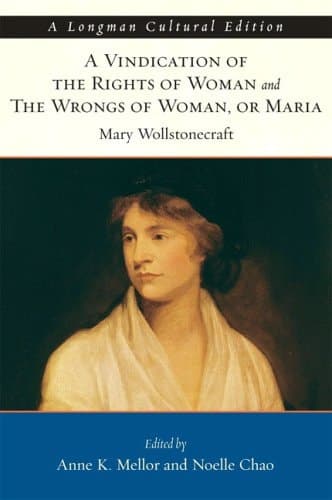
Vindication of the Rights of Woman and The Wrongs of Woman, or Maria (Longman Cultural Editions)
Mary WollstonecraftPublished2006
Pages496
Formatpaperback
PublisherPearson
Synopsis
From Longman's Cultural Editions series, Wollstonecraft, edited by Anne K. Mellor and Noelle Chao, for the first time pairs Wollstonecraft’s feminist tract, the first in English letters, A Vindication of the Rights of Woman, with her unfinished novel, The Wrongs of Woman, or Maria.
By putting tract and novel together, this text presents a far richer and more complex discussion of Wollstonecraft’s political and literary opinions. A wealth of cultural contexts bearing on the “wrongs” of woman (their social and political oppression) in the 18th century and on the development of the Gothic and realist novel further clarify these two texts.
Handsomely produced and affordably priced, the Longman Cultural Editions series presents classic works in provocative and illuminating contexts-cultural, critical, and literary. Each Cultural Edition consists of the complete text of an important literary work, reliably edited, headed by an inviting introduction, and supplemented by helpful annotations; a table of dates to track its composition, publication, and public reception in relation to biographical, cultural and historical events; and a guide for further inquiry and study.
Recommendations
Generating recommendations…
Our AI is preparing recommendations for Vindication of the Rights of Woman and The Wrongs of Woman, or Maria (Longman Cultural Editions). This usually takes under a minute.
About Mary Wollstonecraft
M
Mary Wollstonecraft
1759–1797
Mary Wollstonecraft (pronounced /ˈwʊlstən.krɑːft/; 27 April 1759 – 10 September 1797) was an eighteenth-century British writer, philosopher, and advocate of women's rights. During her brief career, she wrote novels, treatises, a travel narrative, a history of the French Revolution, a conduct book, and a children's book. Wollstonecraft is best known for *A Vindication of the Rights of Woman* (1792), in which she argues that women are not naturally inferior to men, but appear to be only because they lack education. She suggests that both men and women should be treated as rational beings and imagines a social order founded on reason.
View author page