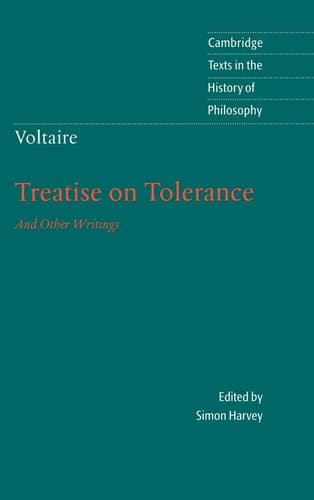
Voltaire: Treatise on Tolerance
VoltairePublished2000
Pages190
Formathardcover
PublisherCambridge University Press
Synopsis
The works presented in this volume, in a new English translation, are among the most important and characteristic texts of the Enlightenment, and bring together all three aspects of Voltaire: the writer, the doer and the philosophe. Originating in Voltaire's campaign to exonerate Jean Calas, they are works of polemical brilliance, informed by his deism and humanism and by Enlightenment values and ideals more generally. The issues that they raise, concerning questions of tolerance and human dignity, are still highly relevant to our own times.
Recommendations
Generating recommendations…
Our AI is preparing recommendations for Voltaire: Treatise on Tolerance. This usually takes under a minute.
About Voltaire
V
Voltaire
1694–1778
François-Marie Arouet, better known by the pen name Voltaire, was a French Enlightenment writer and philosopher famous for his wit and for his advocacy of civil liberties, including freedom of religion and free trade. Voltaire was a prolific writer and produced works in almost every literary form including plays, poetry, novels, essays, historical and scientific works, more than 20,000 letters and more than 2,000 books and pamphlets. He was an outspoken supporter of social reform, despite strict censorship laws and harsh penalties for those who broke them. As a satirical polemicist, he frequently made use of his works to criticize intolerance, religious dogma and the French institutions of his day. Voltaire was one of several Enlightenment figures (along with Montesquieu, John Locke and Jean-Jacques Rousseau) whose works and ideas influenced important thinkers of both the American and French Revolutions. ([Source][1]) [1]: http://en.wikipedia.org/wiki/Voltaire
View author page