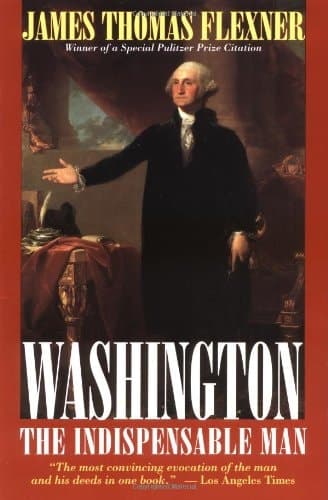
Washington: The Indispensable Man
James Thomas FlexnerPublished1994
Pages448
Formatpaperback
PublisherBack Bay Books
Synopsis
After more than two decades, this dramatic and concise single-volume distillation of James Thomas Flexner's definitive four-volume biography George Washington, which received a Pulitzer Prize citation and a National Book Award for the fourth volume, has itself become an American classic. Now in a new trade paperback edition, this masterful work explores the Father of Our Country - sometimes an unpopular hero, a man of great contradictions, but always a towering historical figure, who remains, as Flexner writes in these pages, a fallible human being made of flesh and blood and spirit - not a statue of marble and wood... a great and good man. The author unflinchingly paints a portrait of Washington: slave owner, brave leader, man of passion, reluctant politician, and fierce general. His complex character and career are neither glorified nor vilified here; rather, Flexner sets up a brilliant counterpoint between Washington's public and private lives and gives us a challenging look at the man who has become as much a national symbol as the American flag.
Recommendations
On the Sources of Patriarchal Rage The Commonplace Books of William Byrd II and Thomas Jefferson and the Gendering of Power in the Eighteenth Century
by Kenneth A. Lockridge
Meacham does for Jefferson what Flexner does for Washington—he refuses the marble statue treatment and instead shows us a man of genuine contradictions navigating impossible choices. You'll recognize the same unflinching approach to examining a founding father's legacy, including the uncomfortable truths, but Meacham's narrative style is more intimate and psychologically probing, letting you inside Jefferson's mind in ways that complement rather than repeat Flexner's approach.
View book
The Federalist Papers
by Alexander Hamilton
This is my surprise recommendation—it reads nothing like a traditional biography, yet it's the closest thing we have to hearing Washington's contemporaries argue about the very nation he was building. After Flexner's portrait of Washington the reluctant politician, reading these primary arguments about executive power and constitutional design will make you understand the intellectual battlefield he was navigating. It's dense but revelatory, and you'll find yourself rereading passages.
View bookUndue Influence: Wealthy Foundations, Grant Driven Environmental Groups, and Zealous Bureaucrats That Control Your F
Undue Influence: Wealthy Foundations, Grant Driven Environmental Groups, and Zealous Bureaucrats That Control Your F
by Ron Arnold
Chernow applies a similar biographical philosophy to Ulysses S. Grant—examining a military leader whose public reputation obscured a more nuanced private reality. Like Flexner, Chernow is interested in how a reluctant man gets pulled into positions of immense power, and he has the same gift for making you understand the weight of decisions made under impossible pressure. The parallel between Washington's and Grant's relationships with power is genuinely illuminating.
View book
The Killer Angels
by Michael Shaara
Here's where I'm asking you to trust me: this Civil War novel captures something about the interior lives of leaders under siege that pure biography sometimes misses. Shaara gets at the human cost of command decisions the way Flexner does—the exhaustion, the doubt, the weight of knowing thousands depend on your judgment. It's historical fiction, yes, but it's written by someone who understood military history as deeply as any academic, and it'll deepen your appreciation for what Washington carried.
View book
The Federalist Era, 1789-1801
by John Chester Miller
This scholarly work from the 1990s is the intellectual companion to Flexner—it examines the decade when Washington actually had to implement the Constitution he'd helped create. Where Flexner gives you the man, Elkins and McKitrick give you the moment, showing how Washington's decisions shaped everything that followed. It's more demanding reading, but it's the book that answers the question: 'What did Washington actually *do* with all that power?'
View bookAbout James Thomas Flexner
J
James Thomas Flexner
1908–2003
Biography coming soon.
View author page