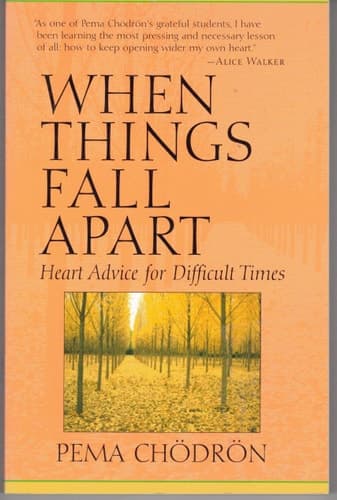
When Things Fall Apart Heartfelt Advice for Hard Times
Pema ChödrönPublished1997
Pages148
Formatpaperback
PublisherShambhala
Synopsis
Still appearing on the Publisher's Weekly bestseller lists, this invaluable guide to finding happiness in difficult times is now available in massmarket for the first time. Pema Chodron reveals the vast potential for happiness, wisdom and courage even in the most painful circumstances. Pema Chodron teaches that there is a fundamental opportunity for happiness right within our reach, yet we usually miss it -- ironically, while we are caught up in attempt to escape pain and suffering. This accessible guide to compassionate living shows us how we can use painful emotions to cultivate wisdom, compassion and courage, ways of communication that lead to openness and true intimacy with others, practices for reversing our negative habitual patterns, methods for working with chaotic situations and ways to cultivate compassionate, energetic social action for anyone -- whether they have a spiritual path or not. Her heartfelt advice and wisdom (developed in her 20 years of practice as a Tibetan Buddhist nun as well as her years previously as a normal 'housewife and mother') give her a wide appeal. This advice strikes just the right note, offering us comfort and challenging us to live deeply and contribute to creating a more loving world.
Recommendations
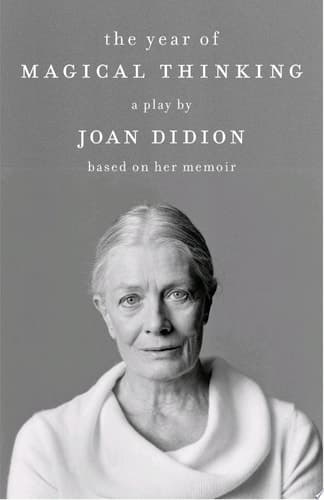
The Year of Magical Thinking A Play by Joan Didion Based on Her Memoir
by Joan Didion
Where Chödrön teaches us to metabolize grief into wisdom, Didion does something rawer—she documents the exact moment when magical thinking fails and we're forced to inhabit loss without escape routes. Both writers refuse sentimentality, but Didion's essayistic precision about her own devastation offers a different kind of permission: that sometimes the work isn't to transform pain immediately, but to witness it with unflinching clarity.
View book
Man's Search for Meaning
by Viktor E. Frankl
Published in 1946, this predates Chödrön's work by decades, yet arrives at strikingly similar terrain from a completely different angle—Frankl's logotherapy emerged from surviving concentration camps rather than Buddhist practice. What makes this pairing powerful is that both authors argue meaning-making is possible even in extremity, but Frankl's framework is more existential and less spiritual, giving you another language for the same hard truths.
View book
The Courage to Be Jewish and the Wife of an Arab Sheik
by Anne Hart
This is a Socratic dialogue between a philosopher and a young man that applies Adlerian psychology to everyday relationships and self-doubt—it's almost like a conversation partner to Chödrön's teachings. Where Chödrön emphasizes compassion and openness, Adler's framework (presented here accessibly) emphasizes radical responsibility and freedom, which can feel like a productive tension rather than contradiction.
View book
Quilting and Braiding The Feminist Christologies of Sallie McFague and Elizabeth A. Johnson in Conversation
by Shannon Schrein
This is my gentle surprise for you—it's not a self-help book at all, but a collection of essays about reciprocity, gratitude, and our relationship with the natural world. Yet it carries the same spiritual generosity as Chödrön's work, just directed outward toward ecology rather than inward toward psychology. Kimmerer's voice has that same quality of hard-won wisdom meeting tenderness, and you'll find the same invitation to see difficulty (like climate change) as a call to deeper engagement rather than despair.
View bookAbout Pema Chödrön
Biography coming soon.
View author page