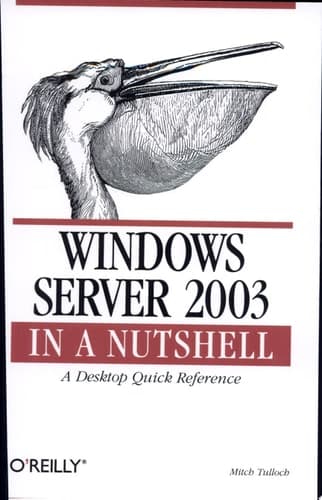
Windows Server 2003 in a Nutshell
Mitch TullochPublished2003
Pages647
Formatpaperback
Publisher"O'Reilly Media, Inc."
Synopsis
So you've decided to adopt Windows Server 2003? Whether you're migrating from Windows 2000 or directly from Windows NT, Windows Server 2003 in a Nutshell is packed with the detailed information that you will need as you administer this OS. To-the-point chapters on migration highlight important new features such as enhancements to Active Directory, shadow volume copies, and Windows Update. Even better for experienced NT and 2000 admins are details about where Microsoft put familiar options, helping you quickly get oriented to the new platform.Those of you familiar with NT or Windows 2000 are well beyond the tutorial stage. Windows Server 2003 in a Nutshell delivers a no-fluff guide with two alphabetical references, one for the GUI and one for the command-line. The Task Map chapter lets you find look up a task (such as "troubleshooting startup issues") to find appropriate topics in the references. Once you know where you're going, the book offers numerous step-by-step procedures in highly condensed form. This quick lookup reference is ideal for administration and deployment, as well as deeper issues such as planning, configuring, and troubleshooting.The GUI chapter is organized by topic according to major themes of Windows Server 2003 administration, providing one-stop shopping for busy admins. For example, if you want to find out about Active Directory and how to manage it, you'd begin by turning to Active Directory. Each topic begins with a description of basic concepts, followed by a description of tools (such as Microsoft Management Console snap-ins) used to administer the feature, instructions on how to perform common or important administrative tasks, and notes detailing subtle points and potential gotchas.Windows Server 2003 offers greatly enhanced command-line administration, and the command reference prominently highlights the many new commands in this release. Dozens of new commands and scripts have been added for administration of Active Directory, disks, event logs, Group Policy, IIS, network diagnostics, the pagefile, printers, processes, shared folders, and the Registry. The result is a Windows operating system platform that now rivals Unix in its ability to support command-line and scripted administration.Microsoft has introduced the right server for a world now dominated by highly distributed systems and web-based server applications, and O'Reilly has written a book that will earn a prominent place on administrators' desk tops.
Recommendations
TCP/IP Illustrated
by W. Richard Stevens
You've clearly got the patience for technical depth, and Stevens writes with the same methodical, no-nonsense approach Tulloch uses—but he goes several layers deeper into the networking foundations that Windows Server 2003 relies on. If you're administering servers, understanding TCP/IP at this level transforms you from someone following procedures to someone who actually knows why things work.
View book
The Practice of System and Network Administration
by Thomas A. Limoncelli
Where Tulloch gives you the *what* and *how* of Windows Server 2003, Limoncelli addresses the *why* behind good administration practices—documentation, change management, automation philosophy. It's the book that separates admins who keep systems running from admins who build systems that run themselves, and it's written with the same practical, task-oriented mindset you just finished reading.
View book
Programming Ruby The Pragmatic Programmers' Guide
by David Thomas
Here's the curveball: this isn't about Windows Server at all, but it's written for the same reader—someone who values efficiency, automation, and getting things done without ceremony. Thomas and Hunt write about scripting, debugging, and problem-solving in ways that'll make you rethink how you approach those command-line tasks in your reference section. It's the mindset book for technical people who actually want to work smarter.
View book
MCSE Guide to Designing a Microsoft Windows Server 2003 Active Directory and Network Infrastructure
by Brian Barber
Tulloch's book touches on Active Directory as one feature among many, but Desmond treats it as the architectural heart of Windows Server administration—which it genuinely is. Since you're clearly working with 2003 specifically, this deep-dive into AD design, troubleshooting, and optimization will turn those condensed procedures into actual understanding of how your directory service should function.
View book
The Art of Computer Systems Performance Analysis: Techniques for Experimental Design, Measurement, Simulation, and Modeling
by Raj Jain
This one's from 1991—older than your Windows Server book—but it's the foundational text for understanding *why* your servers perform the way they do. If you're administering production systems, Jain teaches you how to measure, analyze, and actually prove where bottlenecks exist rather than guessing. It's the methodological backbone that separates reactive troubleshooting from strategic optimization.
View bookAbout Mitch Tulloch
Biography coming soon.
View author page