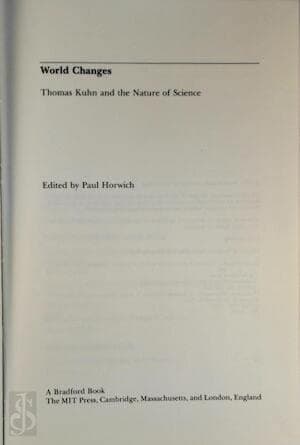
World Changes Thomas Kuhn and the Nature of Science
Thomas S. KuhnPublished1993
Pages356
Formathardcover
PublisherMIT Press
Synopsis
Thomas Kuhn is perhaps the most widely known and influential philosopher of science of our time. His book The Structure of Scientific Revolutions called into question such central notions of scientific method as the concept of absolute truth, the observation/theory distinction, the determinate rationality of theory choice, and the normative function of philosophy of science. It replaced these with a historically more accurate model of scientific change. Kuhn's critique turned several fields upside down and continues to be read and debated not only by philosophers and historians of science but also by many practicing scientists. Inspired by his contributions, these twelve original essays address central aspects of Kuhn's thought. Most of the essays are philosophical, four are primarily historical, and one, by Kuhn himself, responds to issues raised in the other essays.
Paul Horwich is Professor of Philosophy at the Massachusetts Institute of Technology. He is the author of Probability and Evidence, Asymmetries in Time, and Truth.
The essays: Introduction, Paul Horwich. Thomas Kuhn, Colleague and Friend, C.G. Hempel. Carnap, Kuhn, and the Philosophy of Scientific Methodology, John Earman. Remarks on the History of Science and the History of Philosophy, Michael Friedman. Rationality and Paradigm Change in Science, Ernan McMullin. A Mathematicians' Mutiny, with Morals, J. L. Heilbron. Science and Humanism in the Renaissance: Regiomontanus's Oration on the Dignity and Utility of the Mathematical Sciences, N. M. Swerdlow. Design for Experimenting, Jed Z. Buchwald. Mediations: Enlightenment Balancing Acts, or the Technologies of Rationalism, M. Norton Wise. How We Relate Theory to Observation, Nancy Cartwright. Working in a New World. The Taxonomic Solution, Ian Hacking. Afterwords, Thomas Kuhn.
A Bradford Book
Recommendations
The Golem and the Wondrous Deeds of the Maharal of Prague
by Yudl Rosenberg
You've just spent time with Kuhn's argument that scientific paradigms shape how we see reality itself—Wecker does something remarkably similar with folklore and immigrant experience in 1900s New York. She builds an entire world where two mythological beings navigate a society with its own unspoken rules and assumptions, and the novel quietly demonstrates how different frameworks for understanding the world can coexist and clash, much like competing scientific paradigms.
View book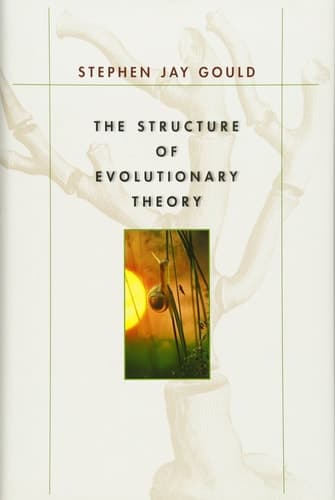
The Structure of Evolutionary Theory
by Stephen Jay Gould
Gould was deeply influenced by Kuhn's work, and this massive tome applies Kuhnian thinking directly to evolutionary biology—examining how Darwin's revolution reshaped biology and how subsequent paradigm shifts (like punctuated equilibrium) challenge our assumptions about gradual change. It's philosophy of science meeting natural history, written by someone who understands both the technical details and the larger intellectual stakes.
View book
The Savage Detectives A Novel
by Roberto Bolaño
Here's the surprise: this sprawling, genre-defying novel about a group of poets searching for a disappeared writer is fundamentally about competing interpretations and the impossibility of establishing objective truth—themes that echo throughout Kuhn's critique of scientific objectivity. Bolaño's fragmented narrative structure mirrors the way different observers construct radically different accounts of the same events, making it a kind of literary exploration of paradigm incommensurability.
View book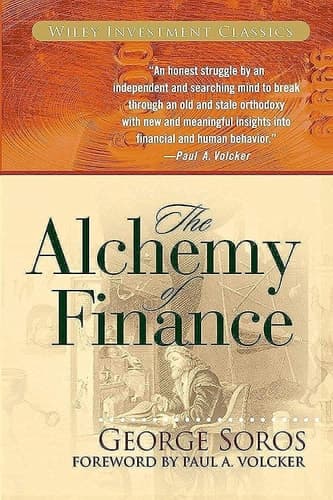
The Alchemy of Finance
by George Soros
Soros explicitly builds his theory of reflexivity on Kuhnian ideas about how observers shape what they observe—arguing that financial markets operate under paradigms that become self-fulfilling until they collapse. It's Kuhn applied to economics and markets, showing how his insights about scientific revolutions illuminate other domains where human interpretation creates reality rather than simply reflecting it.
View book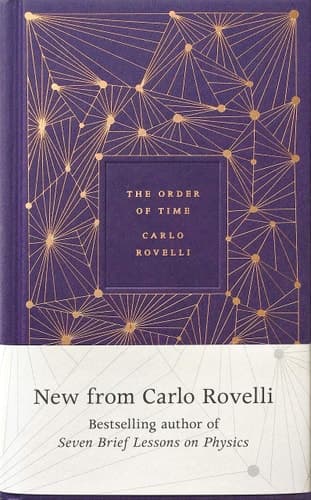
The Order of Time
by Carlo Rovelli
A physicist and philosopher examines how our understanding of time has undergone revolutionary shifts—from Newton to Einstein to quantum mechanics—and Rovelli writes with genuine wonder about how each paradigm seemed obvious to those working within it, yet proved incomplete. It's a contemporary meditation on exactly the kind of scientific transformation Kuhn described, written by someone still doing the work of science rather than just analyzing it from the outside.
View bookAbout Thomas S. Kuhn
T
Thomas S. Kuhn
1922–1996
American historian, physicist and philosopher
View author page