“Quotation confesses inferiority.”
0 likes
Author detail
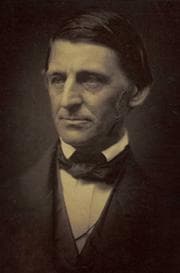
Ralph Waldo Emerson was an American philosopher, essayist, and poet, best remembered for leading the Transcendentalist movement of the mid-19th century. His teachings directly influenced the growing New Thought movement of the mid-1800s. He was seen as a champion of individualism and a prescient critic of the countervailing pressures of society. Emerson gradually moved away from the religious and social beliefs of his contemporaries, formulating and expressing the philosophy of Transcendentalism in his 1836 essay, Nature. As a result of this ground-breaking work he gave a speech entitled The American Scholar in 1837, which Oliver Wendell Holmes, Sr. considered to be America's "Intellectual Declaration of Independence". Considered one of the great orators of the time, Emerson's enthusiasm and respect for his audience enraptured crowds. His support for abolitionism late in life created controversy, and at times he was subject to abuse from crowds while speaking on the topic. When asked to sum up his work, he said his central doctrine was "the infinitude of the private man." ([Source][1]) [1]: http://en.wikipedia.org/wiki/Ralph_Waldo_Emerson
Quotes
Showing 261-280 of 515
“Quotation confesses inferiority.”
0 likes
“If the stars should appear one night in a thousand years, how would men believe and adore; and preserve for many generations the remembrance of the city of God which had been shown! But ever...”
“I like the silent church before the service begins, better than any preaching.”
0 likes
“The religion of one age is the literary entertainment of the next.”
0 likes
“A sect or party is an elegant incognito devised to save a man from the vexation of thinking.”
0 likes
“I remember an answer which when quite young I was prompted to make to a valued adviser who was wont to importune me with the dear old doctrines of the church. On my saying, What have I to do...”
0 likes
“the mystic must be steadily told,—All that you say is just as true without the tedious use of that symbol as with it. Let us have a little algebra, instead of this trite rhetoric,—universal...”
0 likes
“The good news is that the moment you decide that what you know is more important than what you have been taught to believe, you will have shifted gears in your quest for abundance. Success c...”
0 likes
“To laugh often and much; to win the respect of the intelligent people and the affection of children; to earn the appreciation of honest critics and endure the betrayal of false friends; to a...”
1 likes
“Be an opener of doors”
0 likes
“Enthusiasm is one of the most powerful engines of success. When you do a thing do it with all your might. Be active, be energetic, be enthusiastic and faithful, and you will accomplish your...”
0 likes
“Miss Austen’s novels … seem to me vulgar in tone, sterile in artistic invention, imprisoned in the wretched conventions of English society, without genius, wit, or knowledge of the world. Ne...”
0 likes
“Without ambition one starts nothing. Without work one finishes nothing. The prize will not be sent to you. You have to win it.”
0 likes
“The years teach much the days never know.”
0 likes
“But man postpones or remembers; he does not live in the present, but with reverted eye laments the past, or, heedless of the riches that surround him, stands on tiptoe to foresee the future....”
“We are students of words: we are shut up in schools, and colleges, and recitation -rooms, for ten or fifteen years, and come out at last with a bag of wind, a memory of words, and do not kno...”
0 likes
“Why covet a knowledge of new facts? Day and night, house and garden, a few books, a few actions, serve us as well as would all trades and all spectacles. We are far from having exhausted the...”
0 likes
“Men love to wonder, and that is the seed of science.”
0 likes
“Some books leave us free and some books make us free.”
0 likes
“In the highest civilization, the book is still the highest delight. He who has once known its satisfactions is provided with a resource against calamity.”
0 likes