“Life is our dictionary.”
0 likes
Author detail
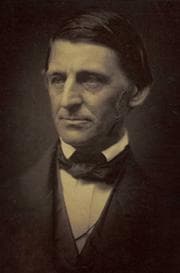
Ralph Waldo Emerson was an American philosopher, essayist, and poet, best remembered for leading the Transcendentalist movement of the mid-19th century. His teachings directly influenced the growing New Thought movement of the mid-1800s. He was seen as a champion of individualism and a prescient critic of the countervailing pressures of society. Emerson gradually moved away from the religious and social beliefs of his contemporaries, formulating and expressing the philosophy of Transcendentalism in his 1836 essay, Nature. As a result of this ground-breaking work he gave a speech entitled The American Scholar in 1837, which Oliver Wendell Holmes, Sr. considered to be America's "Intellectual Declaration of Independence". Considered one of the great orators of the time, Emerson's enthusiasm and respect for his audience enraptured crowds. His support for abolitionism late in life created controversy, and at times he was subject to abuse from crowds while speaking on the topic. When asked to sum up his work, he said his central doctrine was "the infinitude of the private man." ([Source][1]) [1]: http://en.wikipedia.org/wiki/Ralph_Waldo_Emerson
Quotes
Showing 421-440 of 515
“Life is our dictionary.”
0 likes
“What is a weed? A plant whose virtues have never been discovered.”
0 likes
“In all my lectures, I have taught one doctrine, namely, the infinitude of the private man.”
0 likes
“The value of a dollar is social, as it is created by society.”
0 likes
“Reality is a sliding door.”
0 likes
“Every wall is a door.”
0 likes
“Truth is beautiful, without doubt; but so are lies.”
0 likes
“Great hearts steadily send forth the secret forces that incessantly draw great events.”
0 likes
“Judge of your natural character by what you do in your dreams.”
0 likes
“Each age, it is found, must write its own books; or rather, each generation for the next succeeding.”
0 likes
“Great men or men of great gifts you shall easily find, but symmetrical men never.”
0 likes
“Cause and effect are two sides of one fact.”
0 likes
“The best effort of a fine person is felt after we have left their presence.”
0 likes
“Can anything be so elegant as to have few wants, and to serve them one's self?”
0 likes
“A man is the whole encyclopedia of facts.”
0 likes
“Win as if you were used to it, lose as if you enjoyed it for a change.”
0 likes
“We have listened too long to the courtly Muses of Europe.”
0 likes
“God screens us evermore from premature ideas.”
0 likes
“Every man I meet is in some way my superior.”
0 likes
“The highest revelation is that God is in every man.”
0 likes