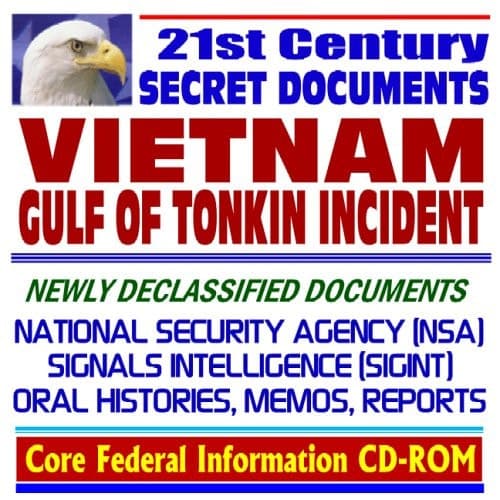
21st Century Secret Documents – Vietnam and the Gulf of Tonkin Incident, Newly Declassified National Security Agency (NSA) Documents, Signals Intelligence, Histories and Reports (CD-ROM)
U.S. GovernmentPublished2006
Pages17164
FormatCD-ROM
PublisherProgressive Management
Synopsis
This up-to-date and informative CD-ROM provides a unique and complete collection of documents about Vietnam and the Gulf of Tonkin incident with newly declassified National Security Agency (NSA) documents, signals intelligence, histories and reports. These reports provide important new information on this controversy. In late 2005, the National Security Agency (NSA) released the first installment of previously classified information regarding the Vietnam era, specifically the Gulf of Tonkin incident. This release includes a variety of articles, chronologies of events, oral history interviews, signals intelligence (SIGINT) reports and translations, and other related memoranda. The Gulf of Tonkin incident, like others in our nation's history, has become the center of considerable controversy and debate. It is not NSA's intention to prove or disprove any one set of conclusions, many of which can be drawn from a thorough review of this material. Instead, through this and subsequent public releases, we intend to make as much information as possible available for the many scholars, historians, academia, and members of the general public who find interest in analyzing the information and forming their own conclusions. Chronologies of Events * Miscellaneous Memoranda and Notes * Material relating to proposed "History of Southeast Asia" article by NSA Historian William Gerhard, circa 1972 * Articles * Oral History Interviews * Signals Intelligence (SIGINT) Reports (R) and Translations (T) Mar 64 - Oct 64 * Related Command and Technical Messages from 02 Aug 64 to 26 Aug 64. In all, the disc has over 17,000 pages reproduced using Adobe Acrobat PDF software - allowing direct viewing on Windows and Apple Macintosh systems. Reader software is included on the CD. As a bonus, this disc also includes a virtual federal reference bookshelf of 18 vital and interesting core federal documents with extraordinary material: HISTORIC AND FOUNDING DOCUMENTS - Constitution with Index, Declaration of Independence; Constitution as amended with Unratified Amendments and Analytical Index; Pocket Version; Emancipation Proclamation 1863. GOVERNMENT FUNCTIONS AND CONGRESSIONAL DOCUMENTS - How Laws are Made House of Representatives; Management Challenges Facing the New Administration; American Government; Minutes of the Senate Democratic Conference 1903-1964 Minutes of the Senate Republican Conference 1911-1964. U.S. GOVERNMENT MANUALS - Complete reproductions from 1997 through the brand-new 2005-06 edition (nine documents). As the official handbook of the Federal Government, The United States Government Manual provides comprehensive information on the agencies of the legislative, judicial, and executive branches. Our CD-ROMs are designed to provide a convenient user-friendly reference work, utilizing the benefits of the Acrobat format to uniformly present thousands of pages that can be rapidly reviewed or printed without untold hours of tedious searching and downloading. Vast archives of important public domain government information that might otherwise remain inaccessible are available for instant review no matter where you are. This book-on-a-disc makes a great reference work and educational tool.
Recommendations
The Pentagon Papers The Defense Department History of United States Decisionmaking on Vietnam
by Senator Mike. Gravel (ed)
You've just spent time with raw declassified signals intelligence—now read the comprehensive historical analysis that contextualizes those documents. This gives you the strategic decision-making layer above the NSA's SIGINT reports, showing how policymakers interpreted (or misinterpreted) the intelligence you've been examining.
View book
The Traitor and the Spy Benedict Arnold and John André
by James Thomas Flexner
Le Carré spent years in actual intelligence work, and it shows—he understands how signals intelligence actually gets used (and misused) in Cold War decision-making. Where your CD-ROM showed you the raw SIGINT from Vietnam, this book reveals how a real Soviet defector's intelligence shaped the entire Cold War narrative, giving you the human drama behind classified documents.
View book
The Sum of Things
by Olivia Manning
This is the curveball recommendation: you've been reading dense government documents and classified reports, so try something that examines how information itself becomes a status symbol. Currid-Halkett analyzes how access to knowledge (including classified knowledge) shapes power structures—a sociological lens on the very secrecy systems you've been studying.
View book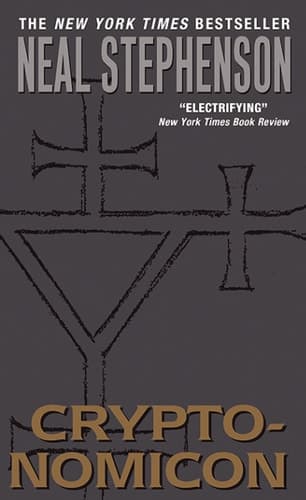
Cryptonomicon Tome 2 : Le Reseau Kinakuta
by Neal Stephenson
Stephenson weaves together World War II codebreaking, modern-day cryptography, and the NSA's actual historical role in signals intelligence into a narrative that makes the technical details sing. If you want to understand *how* the NSA actually processes SIGINT and why it matters, this novel teaches you the mathematics and history in a way that makes those declassified documents suddenly click into place.
View book
Faith in the Fog of War Stories of Triumph and Tragedy in the Midst of War
by Chris Plekenpol
Morris conducted extensive interviews with McNamara, the Defense Secretary who made the crucial decisions during the Gulf of Tonkin incident, and examines how intelligent people make catastrophic decisions with incomplete information. This directly addresses the human judgment layer above all those NSA documents—what happens when decision-makers receive signals intelligence but misinterpret its meaning.
View bookAbout U.S. Government
U
U.S. Government
Born 1776
In 1507, German cartographer Martin Waldseemüller produced a world map on which he named the lands of the Western Hemisphere "America" after Italian explorer and cartographer Amerigo Vespucci. The former British colonies first used the country's modern name in the Declaration of Independence, the "unanimous Declaration of the thirteen united States of America" adopted by the "Representatives of the united States of America" on July 4, 1776. The current name was finalized on November 15, 1777, when the Second Continental Congress adopted the Articles of Confederation, which states, "The Stile of this Confederacy shall be 'The United States of America.'" The short form the United States is also standard. Other common forms include the U.S., the USA, and America. Colloquial names include the U.S. of A. and the States. Columbia, a once popular name for the United States, was derived from Christopher Columbus. It appears in the name "District of Columbia".
View author page