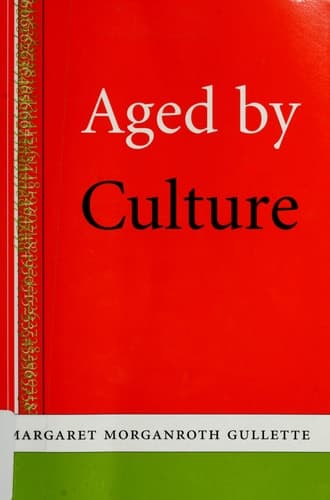
Aged by Culture
Margaret Morganroth GullettePublished2004
Pages267
Formatpaperback
PublisherUniversity of Chicago Press
Synopsis
Americans enjoy longer lives and better health, yet we are becoming increasingly obsessed with trying to stay young. What drives the fear of turning 30, the boom in anti-aging products, the wars between generations? What men and women of all ages have in common is that we are being insidiously aged by the culture in which we live.
In this illuminating book, Margaret Morganroth Gullette reveals that aging doesn't start in our chromosomes, but in midlife downsizing, the erosion of workplace seniority, threats to Social Security, or media portrayals of "aging Xers" and "greedy" Baby Boomers. To combat the forces aging us prematurely, Gullette invites us to change our attitudes, our life storytelling, and our society. Part intimate autobiography, part startling cultural expose, this book does for age what gender and race studies have done for their categories. Aged by Culture is an impassioned manifesto against the pernicious ideologies that steal hope from every stage of our lives.
Recommendations
The Sum of Things
by Olivia Manning
Like Gullette, Currid-Halkett dissects how consumer culture manufactures anxiety and status anxiety across age groups—but she focuses on how we signal identity through consumption rather than youth obsession. You'll recognize the same sharp cultural critique, but applied to why we buy what we buy and what that reveals about how capitalism ages us psychologically.
View book
The Denial of Death
by Ernest Becker
Published in 1973, this Pulitzer Prize winner gets at the philosophical root of what Gullette diagnoses culturally—our terror of mortality and how societies channel that fear into destructive behaviors. Becker's anthropological approach complements Gullette's contemporary analysis beautifully; reading them together, you'll see how timeless the anxiety is, yet how differently each era weaponizes it.
View book
Strangers Devour the Land: A Chronicle of the Assault upon the Last Coherent Hunting Culture in North America, the Cree Indians of Northern Quebec, and Their Vast Primeval
by Boyce Richardson
Hochschild does what Gullette does—she listens to how ordinary people narrate their lives and discovers the hidden cultural scripts shaping them. But she's embedded in a specific political community, showing how aging anxiety intersects with economic precarity and resentment. It's ethnographic storytelling that validates Gullette's thesis through lived experience.
View book
Simone de Beauvoir's the Second Sex
by George Myerson
Here's your surprise pick: de Beauvoir's 1949 masterwork predates Gullette by decades, but her analysis of how women are constructed by society—and specifically how aging women become invisible—is the intellectual ancestor of Gullette's project. Reading this alongside *Aged by Culture* shows you how feminist theory evolved to address age as a category of oppression, not just gender.
View book
Bowling Alone The Collapse and Revival of American Community
by Robert D. Putnam
Putnam maps the institutional and social structures that have eroded since the mid-20th century—the very scaffolding Gullette argues once protected people from being aged by culture. His data-driven approach gives empirical weight to her argument that we're not just individually anxious; we've collectively dismantled the communities and institutions that once gave aging meaning and security.
View bookAbout Margaret Morganroth Gullette
Biography coming soon.
View author page