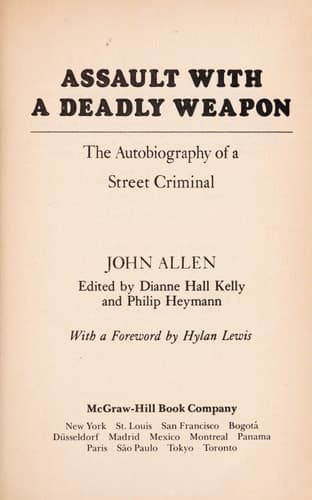
Assault With a Deadly Weapon: The Autobiography of a Street Criminal
John AllenPublished1978
Pages247
Formatpaperback
PublisherMcGraw-Hill
Synopsis
A former gang fighter, burglar, pimp, pusher, and armed robber, paralyzed after being shot in the spine in a gunfight, tells of his twenty-eight years on the streets and in and out of the jails of Washington, D.C
Recommendations

Lion Of Jordan: The Life Of King Hussein In War And Peace
by Avi Shlaim
King constructs this narrative around a man looking back at the formative violence and betrayals of his youth in 1960s Connecticut, using that same unflinching, granular detail Allen brings to street life. Where Allen documents the mechanics of crime and survival, King examines how those early traumas calcify into the choices we make—both authors refuse to sentimentalize or excuse their characters' worlds.
View book
Monster
by Walter Dean Myers
Myers tells the story of a sixteen-year-old accused of murder through screenplay, journal entries, and legal documents—a formally inventive approach that captures the same raw, unmediated voice Allen uses. Like Allen's account, it refuses easy moral judgments and instead lets you sit inside the perspective of someone the system has already decided is guilty, forcing you to reckon with institutional dehumanization.
View book
One Day, when I was Lost A Scenario Based on Alex Haley's "The Autobiography of Malcolm X"
by James Baldwin
Like Allen, Malcolm X documents street life, incarceration, and the possibility of transformation—but he's working through ideology and faith alongside survival. The parallel structure is striking: both men move through crime and imprisonment, but where Allen's narrative is grounded in the granular details of D.C. street economics, Malcolm X is simultaneously constructing a political philosophy. They're almost inverse mirrors of the same era.
View book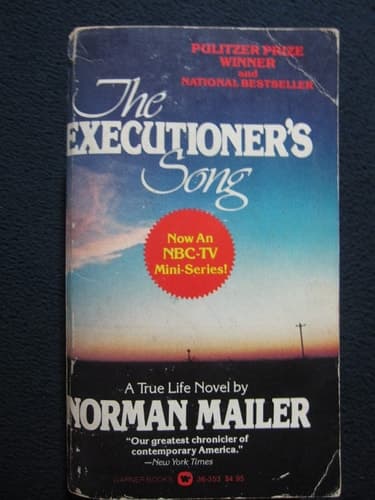
The Executioner's Song
by Norman Mailer
This is my surprise pick for you: Mailer constructs a biography of Gary Gilmore (executed in 1977, just as Allen's book was being published) using interviews, court documents, and letters—creating something that reads like a novel but operates as meticulous reportage. It shares Allen's interest in how a life gets shaped by circumstance and violence, but Mailer's formal ambition and his obsession with the *texture* of American criminality gives you a different angle on the same material.
View book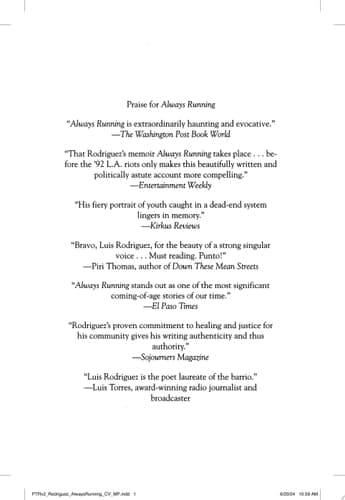
Always Running La Vida Loca: Gang Days in L.A.
by Luis J. Rodriguez
Rodriguez writes from inside gang life in 1970s Los Angeles with the same unsentimental precision Allen brings to D.C., but he's also writing as someone who escaped and is now reflecting on what that escape cost and what it meant. Published in 1993, it gives you a later perspective on the same era of American street culture—you'll see how the patterns Allen documents have evolved and persisted across two decades and two coasts.
View bookAbout John Allen
J
John Allen
Born 1941
John L. Allen is a former chairman of the Department of Geography and emeritus professor of geography at the University of Wyoming in Laramie. His publications, numbering more than thirty titles to date, reflect his broadly varied interests, including the exploration of the American West, human impacts on natural environments and related landscape changes, and images of the West. Among students of the Lewis and Clark expedition, Professor Allen’s best-known work is Lewis and Clark and the Image of the American Northwest (reprint, New York: Dover, 1975). Originally published under the title Passage through the Garden: Lewis and Clark and the Image of the American Northwest, it remains among the most authoritative and frequently-referenced works in the literature.-Discover Lewis&Clark
View author page