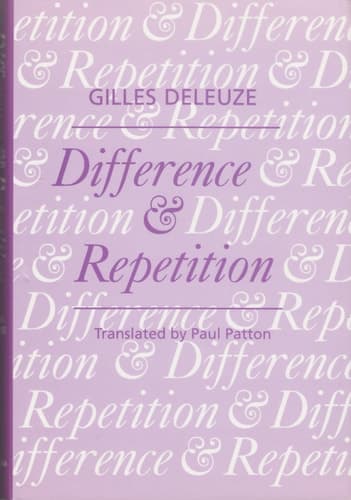
Difference and Repetition
Gilles DeleuzePublished1994
Pages350
Formathardcover
PublisherColumbia University Press
Synopsis
Difference and Repetition, a brilliant exposition of the critique of identity, has come to be considered a contemporary classic in philosophy and one of Deleuze's most original works. Successfully defended in 1969 as Deleuze's main thesis toward his Doctorat d'Etat at the Sorbonne, the work has been central in initiating the shift in French thought away from Hegel and Marx, towards Nietzsche and Freud. The text follows the development of two central concepts, those of pure difference and complex repetition. It shows how the two concepts are related - difference implying divergence and decentering, and repetition implying displacement and disguising. In its explication the work moves deftly between Hegel, Kierkegaard, Freud, Althusser, and Nietzsche to establish a fundamental critique of Western metaphysics. Difference and Repetition has become essential to the work of literary critics and philosophers alike, and this translation his been long awaited.
Recommendations

A Thousand Plateaus Capitalism and Schizophrenia
by Gilles Deleuze
I know you've just finished Deleuze, but this collaborative work takes the concepts you've grappled with—difference, multiplicity, deterritorialization—and applies them across culture, politics, and linguistics in ways that feel almost like watching him think in real time. Where Difference and Repetition builds the philosophical scaffolding, this book shows you what you can construct with it.
View book
The Savage Detectives A Novel
by Roberto Bolaño
This is my surprise pick for you—a novel rather than philosophy, but Bolaño's narrative structure embodies Deleuzian principles rather than merely discussing them. The book refuses a centered perspective, scatters across time and voices, and makes meaning through repetition and variation rather than linear progression. It's what happens when a novelist has genuinely internalized the critique of identity you've just read.
View book
Nietzsche and Philosophy
by Gilles Deleuze
Since Deleuze moves through Nietzsche so deliberately in Difference and Repetition, this earlier monograph gives you the full genealogy of that engagement—you'll see exactly how Deleuze constructs his reading of Nietzsche's critique of Platonism and reactive forces. It's denser in some ways, clearer in others, and absolutely essential for understanding the Nietzschean architecture holding up everything you just finished.
View book
A Commentary on Jean-Paul Sartre's Being and Nothingness
by Joseph S. Catalano
I'm sending you backward here deliberately—Sartre's massive phenomenology is the philosophical opponent Deleuze is arguing against throughout Difference and Repetition, particularly on questions of identity and essence. Reading this first (or alongside) will give you the full dialectical picture: you'll understand exactly what Deleuze is dismantling and why his alternative matters so much.
View book
The Order of Things (Routledge Classics)
by Michel Foucault
Foucault's archaeology of knowledge shares Deleuze's interest in how systems of thought organize reality, but approaches it through historical rupture and epistemic breaks rather than ontological difference. You'll find yourself in conversation with both thinkers—Foucault asking how knowledge gets structured, Deleuze asking what escapes that structure. They're not saying the same thing, which is precisely why reading them together clarifies both.
View bookAbout Gilles Deleuze
Biography coming soon.
View author page