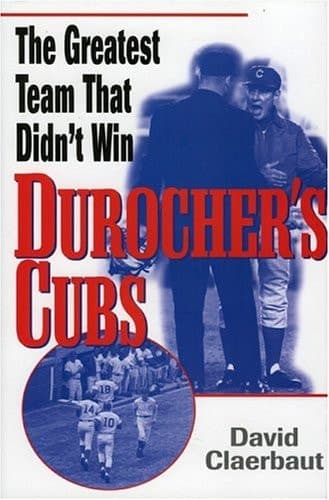
Durocher's Cubs The Greatest Team That Didn't Win
David ClaerbautPublished2000
Pages226
Formathardcover
PublisherTaylor Publishing Company
Synopsis
For twenty years, 1946-65, the Chicago Cubs were mired in the second division of the National League. With little talent, they were usually out of it by Memorial Day. That all changed in the mid-sixties when the Cubs posted six straight winning seasons, reviving the franchise and generating almost unprecedented interest in the team. But they never won anything: not a World Series, not a pennant, not even a division title. This alone is not remarkable. What is remarkable, however, is that the Cubs fielded a veritable who's who of All-Stars and future Hall of Famers -- and yet never won. Managed by the Hall-of-Fame skipper Leo Durocher, the team included Ernie Banks, Billy Williams, Ferguson Jenkins, Ron Santo, Glenn Beckert, Don Kessinger, and Randy Hundley. To have such a collection of diamond luminaries and still not win is nearly unprecedented.Based on dozens of interviews with key participants and painstaking research, Durocher's Cubs recreates the magic of those years and explores what really happened on the field, in the clubhouse, and in the gilded offices of William Wrigley, the team's owner. It explains why this team is so fondly remembered. Finally, and most importantly, it answers the question that has left many Cub fans and baseball historians scratching their heads: why did this team, so laden with talent, never win?
Recommendations

A Foreigner Carrying in the Crook of His Arm a Tiny Book
by Edmond Jabes
Like Claerbaut, Passan investigates why certain physical gifts don't always translate to championship success—but he does it through the lens of pitching talent and the biomechanics that teams obsess over. You'll get that same detective-work feeling of uncovering what happens behind the scenes when talent meets organizational structure, except here the mystery is why elite arms sometimes flame out rather than why they never quite win.
View book
Moneyball The Art Of Winning An Unfair Game
by Michael Lewis
This explores the inverse problem—how a team with *less* talent than the Cubs managed to compete by understanding what talent actually matters. Lewis writes with the same narrative drive Claerbaut uses to pull you through the Cubs' story, and you'll find yourself thinking about how differently the Durocher era might've unfolded if someone had been asking the right questions about player evaluation.
View book
Disaster on Mount Slesse: The Story of Western Canada's Worst Air Crash
by Betty O'Keefe
This might seem like a departure, but Egan does something Claerbaut also does beautifully: he takes a historical period most people know only in broad strokes and reconstructs it through dozens of individual voices and meticulous research. The result is a story about systemic failure and human resilience that feels as gripping as any sports narrative—just with higher stakes and no box scores.
View book
Asbury Park's Glory Days The Story of an American Resort
by Helen C. Pike
Published in 1966, this collection of interviews with early baseball legends captures something Claerbaut clearly values—letting the people who lived through an era speak directly about what it was actually like. Where Durocher's Cubs is about a specific team's tragedy, this is about an entire generation's experience, and the intimacy of the interview format will feel familiar to you.
View book
Mullahs, Merchants, and Militants The Economic Collapse of the Arab World
by Stephen Glain
Here's the curveball: Roose examines how institutions fail to communicate truth effectively—which is exactly what happened with the Cubs' front office and fan expectations. This isn't about baseball, but it's about why talented organizations sometimes can't get their story straight, and how narrative and reality diverge. If you're interested in the *why* behind institutional failure, this explores that question in a completely different arena.
View bookAbout David Claerbaut
Biography coming soon.
View author page