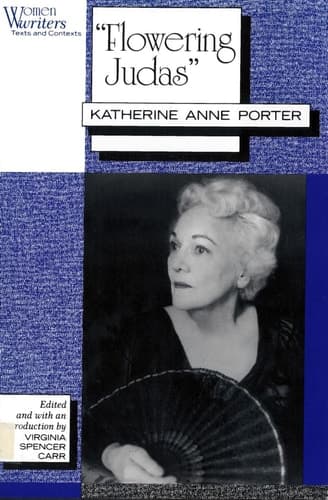
Flowering Judas
Katherine Anne PorterPublished1993
Pages216
Formatpaperback
PublisherRutgers University Press
Synopsis
Katherine Anne Porter often spoke of her story "Flowering Judas" as the tale she liked best of all her stories because it came the nearest to what she meant it to be. It is the story of Laura, an idealistic woman, who travels to Mexico from Arizona at the age of twenty-two to assist the Obregón Revolution.
This casebook on "Flowering Judas" addresses Porter's ambivalence surrounding her roles as woman and artist and also attests to the profound influence of Mexico upon her work. Readers of this early tale will not be surprised to learn that although Porter was a practicing feminist in her life and her work, she actually eschewed the feminist label.
Virginia Spencer Carr brings her own sharply focused biographer's eye to the introduction, further illuminating the story and the superb critical essays that it provokes. The casebook includes the authoritative text of the story itself, Porter's own statement regarding the genesis of this highly acclaimed work, an important interview, a collection of significant essays on "Flowering Judas" and the historical, cultural, and personal milieu from which the tale evolved, a bibliography, and a chronology of Porter's life and work.
Recommendations

The Death of the Heart
by Elizabeth Bowen
Like Porter, Bowen constructs her narratives around a young woman navigating emotional and moral complexity in a world that doesn't quite match her idealism. Both writers excel at that particular tension between what their heroines believe about themselves and what their actions reveal—the gap between intention and consequence becomes the real story.
View book
The Savage Detectives A Novel
by Roberto Bolaño
This is my surprise pick for you—it's a sprawling, formally inventive novel that shares Porter's fascination with idealistic young people caught between revolutionary fervor and personal desire, but set in the Latin American literary underground rather than political revolution. Bolaño writes with the same unflinching eye toward how passion and naïveté can coexist in the same person.
View book
The remains of the day de Kazuo Ishiguro
by Gallix/François
Both Porter and Ishiguro are masters of the unreliable narrator who doesn't quite see their own complicity in the systems around them. Where Laura in 'Flowering Judas' is caught between revolution and self-deception, Stevens here is trapped by his own carefully constructed dignity—the prose style itself becomes a kind of self-protective armor.
View book
Toni Morrison - Beloved
by Carl Plasa
Morrison shares Porter's interest in how historical trauma lives in the body and psyche of individuals, and how women navigate impossible moral choices within systems designed to destroy them. The prose has that same lyrical density, and both writers refuse to simplify their female characters' complicity or suffering.
View book
The Last Leopard: A Life of Giuseppe Tomasi di Lampedusa
by David Gilmour
Published in 1958, this novel shares Porter's preoccupation with revolution and personal transformation—but from the perspective of someone watching the old world collapse. Like 'Flowering Judas,' it's deeply concerned with how individuals are shaped by historical forces they can neither fully understand nor control, written with that same elegant, slightly detached observation.
View bookAbout Katherine Anne Porter
K
Katherine Anne Porter
1890–1980
"Katherine Anne Porter was a Pulitzer Prize-winning American journalist, essayist, short story writer, novelist, and political activist. Her 1962 novel Ship of Fools was the best-selling novel in America that year, but her short stories received much more critical acclaim. She is known for her penetrating insight; her work deals with dark themes such as betrayal, death and the origin of human evil." - Wikipedia
View author page