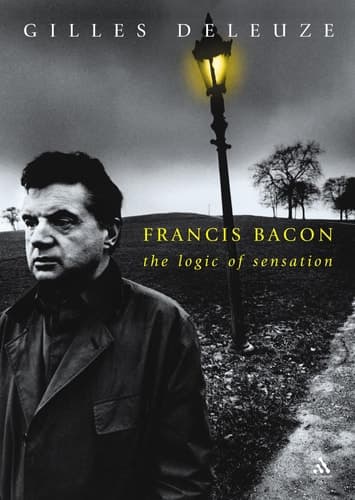
Francis Bacon The Logic of Sensation
Gilles DeleuzePublished2004
Pages209
Formatpaperback
PublisherContinuum
Synopsis
Gilles Deleuze was one of the most influential and revolutionary philosophers of the twentieth century. Francis Bacon: The Logic of Sensation is his long-awaited work on Bacon, widely regarded as one of the most radical painters of the twentieth century.The book presents a deep engagement with Bacon's work and the nature of art. Deleuze analyzes the distinctive innovations that came to mark Bacon's style: the isolation of the figure, the violation deformations of the flesh, the complex use of color, the method of chance, and the use of the triptych form. Along the way, Deleuze introduces a number of his own famous concepts, such as the 'body without organs' and the 'diagram, ' and contrasts his own approach to painting with that of both the phenomenological and the art historical traditions.Deleuze links Bacon's work to CTzanne's notion of a 'logic' of sensation, which reaches its summit in color and the 'coloring sensation.' Investigating this logic, Deleuze explores Bacon's crucial relation to past painters such as Velasquez, CTzanne, and Soutine, as well as Bacon's rejection of expressionism and abstract painting.Long awaited in translation, Francis Bacon is destined to become a classic philosophical reflection on the nature of painting.
Recommendations

The Savage Detectives A Novel
by Roberto Bolaño
Like Deleuze's analysis of Bacon, Bolaño constructs meaning through fragmentation and deformation—his narrative splinters across voices and decades, forcing you to sense the shape of something whole from broken pieces. Both works demand you sit with discomfort and resist the urge to impose conventional order, treating the reader's disorientation as essential to understanding.
View book
Art and Illusion in The Winter's Tale
by B. J. Sokol
Where Deleuze theorizes sensation through Bacon's paint, Gombrich explores how we actually *see* in art—the psychology and history behind visual perception itself. This 1960 classic offers a different philosophical entry into painting that complements rather than repeats Deleuze's approach, grounding aesthetics in cognitive science before that term existed.
View book
Simone de Beauvoir's the Second Sex
by George Myerson
Here's your surprise: de Beauvoir's phenomenological investigation of embodiment and existence shares Deleuze's obsession with the body as a site of meaning-making, but she approaches it through lived experience rather than painting. Her analysis of how bodies are constructed, constrained, and represented resonates deeply with Deleuze's interest in flesh and deformation, just applied to human existence rather than canvas.
View book
The Poetics of Space
by Gaston Bachelard
Bachelard writes about intimate space and imagination the way Deleuze writes about sensation—through poetic intensity rather than systematic argument. His meditation on how rooms, houses, and enclosed spaces generate feeling and memory offers a complementary philosophy of how material forms (architectural rather than painterly) create meaning that bypasses rational analysis.
View book
A Thousand Plateaus Capitalism and Schizophrenia
by Gilles Deleuze
If you found yourself wrestling with Deleuze's concepts like the 'body without organs' and the 'diagram,' this co-authored work (published 1987, a different era) deepens and applies those same ideas across culture, politics, and desire. It's denser than the Bacon book, but you've already proven you can handle Deleuze's density—this extends his thinking into territory that will feel both familiar and radically expansive.
View bookAbout Gilles Deleuze
Biography coming soon.
View author page