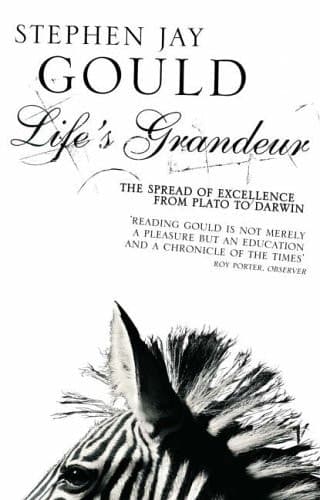
Full House The Spread of Excellence from Plato to Darwin
Stephen Jay GouldPublished1997
Pages244
Formatpaperback
PublisherVintage
Synopsis
In Full House, Gould corrects the prevalent, anthropocentric view of the world with an eloquent argument for a new paradigm of progress in which variety - not complexity - is the true measure of excellence. In the process, Full House teaches us how to read trends as changes in variation within full systems, rather than as "things moving somehwere".
Recommendations
The Structure of Scientific Revolutions
by Thomas S. Kuhn
Kuhn does for paradigm shifts what Gould does for progress—he dismantles the idea that science moves in a straight line toward truth, showing instead how our frameworks for understanding reality fundamentally reshape what we can even see. You'll recognize Gould's intellectual DNA here, but Kuhn focuses on how entire scientific communities reorganize their thinking rather than biological diversity, giving you a complementary angle on the same revolutionary idea.
View book
The Selfish Gene
by Richard Dawkins
Where Gould argues against teleological thinking in evolution, Dawkins reframes the entire mechanism of inheritance itself—not organisms, but genes as the unit of selection. They famously disagreed, but reading Dawkins after Gould gives you the intellectual sparring match that shaped modern evolutionary biology, and you'll find yourself constantly dialoguing with both authors' arguments.
View book
Finite and Infinite Games
by James P. Carse
This is the surprise recommendation: a philosophical meditation on systems and variation that reads almost like poetry, yet shares Gould's core insight that we misunderstand progress by looking for winners and endpoints. Carse applies this to culture, religion, and human purpose rather than biology, but the intellectual move—recognizing that infinite systems don't have destinations—will feel like a natural extension of Gould's thinking into unexpected territory.
View book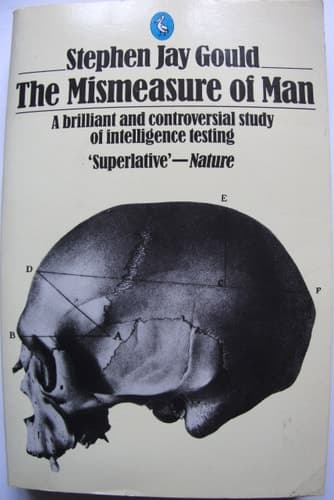
The Mismeasure of Man (Pelican)
by Stephen Jay Gould
Wait—I know what you're thinking. But hear me out: this is Gould's most direct application of Full House's principles to a real-world problem, showing how the obsession with ranking and linear measurement has distorted our understanding of human intelligence and variation itself. It's Gould weaponizing his own philosophy against scientific racism, and it's essential reading for understanding why his paradigm shift matters beyond the ivory tower.
View book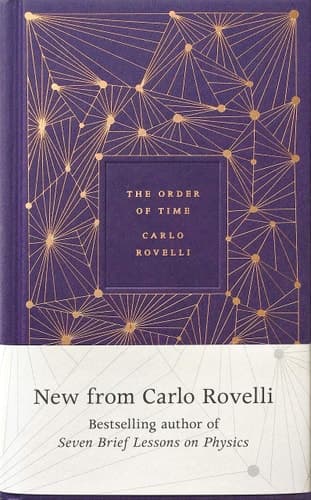
The Order of Time
by Carlo Rovelli
A physicist's meditation on why our intuitions about progress, sequence, and causality are fundamentally wrong—Rovelli shows how time itself doesn't flow the way we assume it does, which is Gould's argument about evolution translated into physics. Published in 2018, it's contemporary but grapples with the same intellectual problem: we project our human experience of directionality onto systems that don't actually work that way.
View bookAbout Stephen Jay Gould
Biography coming soon.
View author page