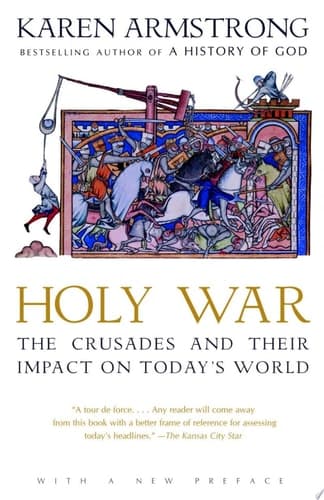
Holy War The Crusades and Their Impact on Today's World
Karen ArmstrongPublished2001
Pages672
Formatpaperback
PublisherKnopf Doubleday Publishing Group
Synopsis
The New York Times bestselling author of A History of God skillfully narrates the history of the Crusades with a view toward their profound and continuing influence.
"Holy War brings compassion, objectivity, breadth, and imagination to the most urgent crisis of our time." —The Boston Phoenix
In 1095 Pope Urban II summoned Christian warriors to take up the cross and reconquer the Holy Land. Thus began the holy wars that would focus the power of Europe against a common enemy and become the stuff of romantic legend. In reality the Crusades were a series of rabidly savage conflicts in the name of piety. And, as Armstrong demonstrates in this fascinating book, their legacy of religious violence continues today in the Middle East, where the age-old conflict of Christians, Jews, and Muslims persists.
Recommendations
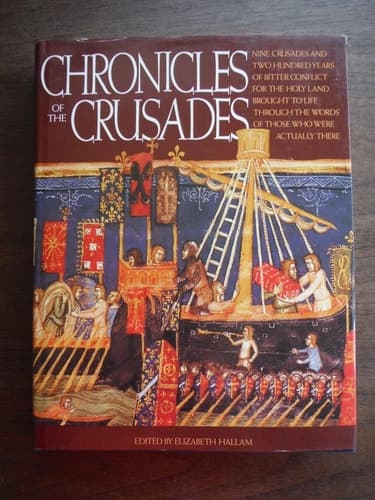
Chronicles of the Crusades Nine Crusades and Two Hundred Years of Bitter Conflict for the Holy Land
by Edited by Elizabeth Hallam
Phillips gives you the granular, ground-level view of what Armstrong sketches in broader strokes—you'll follow individual crusaders, merchants, and civilians whose letters and chronicles reveal how ideology collided with the messy reality of medieval warfare. Where Armstrong shows you the forest, Phillips walks you through the trees, and his narrative style is surprisingly gripping for a 600-page academic work.
View book
The Clash of Civilizations and the Remaking of World Order
by Samuel P. Huntington
Armstrong ends by showing how Crusade-era antagonisms still shape modern geopolitics; Huntington takes that observation and builds an entire framework around it. This is the book that gets argued about in foreign policy circles, and while you may not agree with all his conclusions, it'll deepen your understanding of why the Middle East conflicts Armstrong describes feel so intractable and cyclical.
View book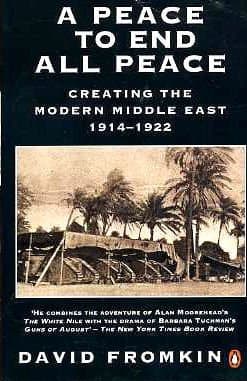
A Peace to End All Peace Creating the Modern Middle East, 1914-1922
by David Fromkin
Here's where Armstrong's historical arc actually *lands* in the modern world. Fromkin traces how World War I and the subsequent carving up of the Ottoman Empire created the exact borders and tensions that fuel today's conflicts—it's the missing chapter that explains how medieval religious wars became 20th-century political ones. His narrative is almost novelistic in how he brings diplomats and generals to life.
View book
El nombre de la rosa / The Name of the Rose
by Umberto Eco
This is your surprise pick—a medieval murder mystery set in a monastery during the Inquisition that's absolutely obsessed with how power, knowledge, and religious authority intertwine. Eco was a semiotician, not a historian, but his novel captures the *texture* of medieval religious thinking in a way that makes Armstrong's analysis feel lived-in. Plus, it's genuinely unputdownable once you get past the first 50 pages.
View book
Edward W. Said's Orientalism A Critique
by Bharat Bhusan Mohanty
Armstrong's book shows you how the Crusades happened; Said shows you how the West *thought about* the East during and after them—and how those distorted perceptions became the lens through which we still view the Middle East today. It's dense, occasionally frustrating, but absolutely foundational if you want to understand how historical narratives get weaponized. This one's from 1978, so it'll give you that earlier-decade perspective too.
View bookAbout Karen Armstrong
K
Karen Armstrong
Born 1944
Karen Armstrong is a British author and commentator known for her books on comparative religion. A former Roman Catholic religious sister, she went from a conservative to a more liberal and mystical Christian faith. - Wikipedia
View author page