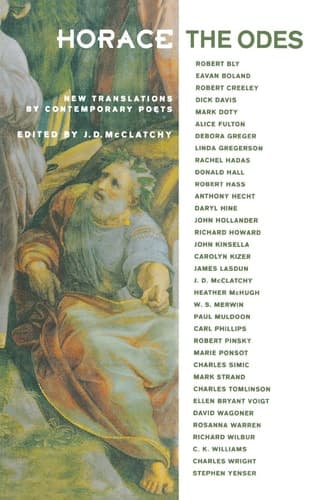
Synopsis
They have inspired poets and challenged translators through the centuries. The odes of Horace are the cornerstone of lyric poetry in the Western world. Their subtlety of tone and brilliance of technique have often proved elusive, especially when--as has usually been the case--a single translator ventures to maneuver through Horace's infinite variety. Now for the first time, leading poets from America, England, and Ireland have collaborated to bring all 103 odes into English in a series of new translations that dazzle as poems while also illuminating the imagination of one of literary history's towering figures.
The thirty-five contemporary poets assembled in this outstanding volume include nine winners of the Pulitzer prize for poetry as well as four former Poet Laureates. Their translations, while faithful to the Latin, elegantly dramatize how the poets, each in his or her own way, have engaged Horace in a spirited encounter across time.
Each of the odes now has a distinct voice, and Horace's poetic achievement has at last been revealed in all its mercurial majesty. In his introduction, J. D. McClatchy, the volume's editor and one of the translators, reflects on the meaning of Horace through the ages and relates how a poet who began as a cynical satirist went on to write the odes. For the connoisseur, the original texts appear on facing pages allowing Horace's ingenuity to be fully appreciated. For the general reader, these new translations--all of them commissioned for this book--will be an exhilarating tour of the best poets writing today and of the work of Horace, long obscured and now freshly minted.
The contributors are Robert Bly, Eavan Boland, Robert Creeley, Dick Davis, Mark Doty, Alice Fulton, Debora Greger, Linda Gregerson, Rachel Hadas, Donald Hall, Robert Hass, Anthony Hecht, Daryl Hine, John Hollander, Richard Howard, John Kinsella, Carolyn Kizer, James Lasdun, J. D. McClatchy, Heather McHugh, W. S. Mervin, Paul Muldoon, Carl Phillips, Robert Pinsky, Marie Ponsot, Charles Simic, Mark Strand, Charles Tomlinson, Ellen Bryantr Voigt, David Wagoner, Rosanna Warren, Richard Wilbur, C. K. Williams, Charles Wright, and Stephen Yenser.
Recommendations
The Art of Poetry
by Unknown
Since you've just experienced how contemporary poets wrestle with translating Horace's compressed wisdom into their own voices, Valéry's meditations on the craft itself will feel like the natural next step—he's essentially doing what those 35 poets were doing, but turning his lens inward to examine *why* we translate and transform classical forms. His essays have that same elegant precision you appreciated in the odes themselves.
View book
The Savage Detectives A Novel
by Roberto Bolaño
This might seem like a departure, but hear me out: Bolaño's novel is essentially a 900-page conversation between poets about poetry, literature, and obsession—structured like a series of interlocking monologues that shift perspective constantly, much like how each translator in your Horace volume brought their own distinct voice to the same source material. It's maximalist where Horace is minimal, but both demand you pay attention to how form shapes meaning.
View book
Look Out Cancer, Here I Come How I Beat the Odds and Came Out a Winner
by Sharon L. Parker
Rather than reading *about* lyric poetry, why not experience a contemporary master doing what Horace did—writing odes to everyday subjects with startling intimacy and technical brilliance? Olds has that same ability to make the mundane luminous, and her odes will show you how the form remains vital and alive in modern hands, which is really what that McClatchy collection was arguing all along.
View book
The Odyssey A Stage Version
by Homer
Since you've just spent time with how multiple translators approach a single classical text, this theatrical adaptation of Homer offers something genuinely different—it's a poet (Bolger) who's also a playwright reimagining epic poetry for the stage, asking what Homer's work *becomes* when you strip away the page and put it in bodies and voices. It's the same impulse as your Horace collection, but applied to a different classical work and a different medium entirely.
View book
Austerlitz
by W. G. Sebald
This is the surprise pick: Sebald's novel reads like someone has woven together fragments of memory, history, and meditation the way those 35 poets wove their individual sensibilities into Horace's odes. There's no plot in the traditional sense—instead, you're moving through layers of time and meaning, piecing together how the past speaks to the present, which is exactly the temporal and emotional work you were doing while reading those odes. It's prose, not poetry, but it has the density and precision of lyric.
View bookAbout Horace
H
Horace
Born 1951
Biography coming soon.
View author page