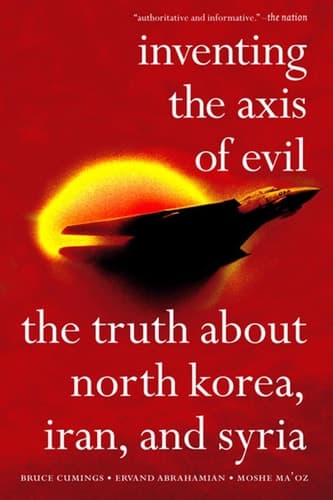
Inventing the Axis of Evil The Truth about North Korea, Iran, and Syria /|cBruce Cumings, Ervand Abrahamian, Moshe Maʻoz
Bruce CumingsPublished2006
Pages213
Formatpaperback
PublisherNew Press
Synopsis
Ever since the "axis of evil" label was first applied by President Bush in his 2002 State of the Union address, the hawks in his administration have left little doubt as to where they intend to turn their attention after Iraq: North Korea, Iran, and Syria. Yet most Americans know very little about these three countries beyond what the Pentagon has told them.
For those wanting to know more about "who's next," this "timely exposition on global (in)stability" (Korean Quarterly) by three leading experts on each country sets the record straight, confronting relentless fearmongering with hard facts. The authors explore each country's history and internal politics alongside the spotty record of past U.S. interventions, including the Korean War and the CIA-sponsored overthrow of Iran's elected prime minister in 1953. As one reviewer pointed out: "The most important thing we know about Syria is that we really don't know what's going on in Syria" (Slate). While entertaining no illusions about these despotic regimes, Inventing the Axis of Evil demonstrates that the truth is far more complicated than some would have us believe.
Recommendations

Killing Hope: U.S. Military and C.I.A. Interventions Since World War II--Updated Through 2003
by William Blum
Blum does for American interventionism what Cumings does for the 'axis of evil' framing—he methodically catalogs decades of U.S. military and covert operations with the same unflinching attention to historical detail and willingness to challenge official narratives. If you appreciated how Cumings contextualized Iraq and Iran through their actual histories rather than Pentagon talking points, Blum's comprehensive approach will feel like a natural deepening of that investigative instinct.
View book
Utopia Guide to Indonesia (2nd Edition) The Gay and Lesbian Scene in 43 Cities Including Jakarta and the Island of Bali
by John Goss
Prashad takes the CIA-Iran 1953 coup that Cumings mentions and expands it into a pattern—showing how that operation became a template Washington repeated across the globe. Where Inventing the Axis of Evil focuses on three countries' perspectives, Prashad traces the American playbook itself, making the connections between seemingly separate interventions feel inevitable rather than coincidental.
View book
The Shock Doctrine The Rise of Disaster Capitalism
by Naomi Klein
Here's where I'm asking you to trust me on a slight genre shift: Klein writes like a journalist-historian (similar to Cumings' grounded approach), but she's investigating how economic ideology gets weaponized during crises—including in countries destabilized by U.S. intervention. It's the economic underbelly of the foreign policy you just read about, showing why these interventions happen and who profits, with the same meticulous documentation you appreciated.
View book
Teaching with Voices of a People's History of the United States by Howard Zinn and Anthony Arnove
by Gayle Olson-Raymer
Published in 1980, this is your 'different decade' pick—and it's essential context for understanding how American foreign policy didn't emerge from nowhere. Zinn's methodology mirrors Cumings': he's deliberately countering the official story by centering voices and perspectives the mainstream narrative ignores. Reading this alongside Inventing the Axis of Evil creates a through-line showing how interventionist impulses have deep American roots.
View book
Open Veins of Latin America Five Centuries of the Pillage of a Continent
by Eduardo Galeano
This is the surprise recommendation—Galeano writes with a poet's intensity rather than academic distance, but his analysis of how imperial powers extract wealth and sovereignty from smaller nations is precisely what Cumings is documenting for Asia and the Middle East. It's the same geopolitical story told in a completely different register, and the lyrical anger might actually clarify patterns you missed in the more measured academic prose.
View bookAbout Bruce Cumings
B
Bruce Cumings
Born 1943
Biography coming soon.
View author page