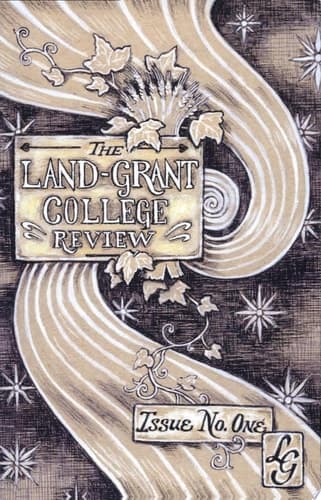
Land-Grant College Review Issue No. One
Aimee BenderPublished2003
Pages196
Formatpaperback
PublisherLand-Grant College Review
Synopsis
The Land-Grant College Review's first issue features new fiction by Aimee Bender, Josip Novakovich, Robert Olmstead, Ron Carlson, and Stephen Dixon, an interview with Thisbe Nissen, and artwork by Joy Kolitsky.
Recommendations
Securing the Commonwealth Debt, Speculation, and Writing in the Making of Early America
by Jennifer J. Baker
Like Bender's work in the Review, Offill builds emotional landscapes through fragmented, precisely-observed moments rather than traditional narrative arcs. Her prose has that same quality of making the mundane suddenly luminous—a sentence about washing dishes or watching your child becomes a small revelation about desire, attention, and what we're willing to sacrifice.
View book
The Vegetarian A Novel
by Kang Han
Han Kang shares Bender's gift for taking a single, seemingly simple decision and letting it ripple outward into something psychologically complex and unsettling. Both writers excel at that moment when you realize the story isn't about what you thought it was—the real drama lives in the spaces between people, in what remains unspoken.
View book
The Apocalyptic Vision of Mikhail Bulgakov's the Master and Margarita (Studies in Slavic Language & Literature)
by Edward E. Ericson
This 1967 novel might seem like a departure, but it shares Bender's playful relationship with reality—the way she can slip between the mundane and the magical without ever announcing the shift. Bulgakov does this across an entire city, weaving together Soviet Moscow, ancient Jerusalem, and the Devil's social calendar with the same deadpan tone Bender uses for her stranger-than-fiction domestic moments.
View book
Promise You Won't Freak Out A Teenager Tells Her Mom the Truth About Boys, Booze, Body Piercing and Other..
by Doris A. Fuller
Machado's collection operates in that same territory Bender explores—where the fantastic and the intimate collide. She'll give you a story about a woman's body literally disappearing, or a relationship told as a video game, but the emotional stakes are always grounded in something achingly human. The formal inventiveness never overshadows the genuine vulnerability underneath.
View book
Remember with Advantages A History of the Tenth, Eleventh and Royal Hussars
by Henry Keown-Boyd
Saunders has that same ability to find profound strangeness in ordinary American life—his characters often exist in slightly-off versions of the world we recognize, which lets him examine loneliness, kindness, and regret with both humor and genuine tenderness. Like Bender, he trusts his readers to sit with uncomfortable emotions without spelling out the moral.
View bookAbout Aimee Bender
Biography coming soon.
View author page