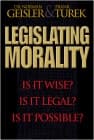
Legislating Morality: Is it Wise? Is it Legal? Is it Possible?
Norman L. GeislerPublished1998
Pages272
Formathardcover
PublisherBethany House Pub
Synopsis
All Laws Legislate Morality Whose Morality Should We Legislate? America’s moral decline is no secret. An alarming number of moral and cultural problems have exploded in our country since 1960—a period when the standards of morality expressed in our laws and customs have been relaxed, abandoned, or judicially overruled. Conventional wisdom says laws cannot stem moral decline. Anyone who raises the prospect of legislation on the hot topics of our day—abortion, family issues, gay rights, euthanasia—encounters a host of "As long as I don’t hurt anyone the government should leave me alone." "No one should force their morals on anyone else." "You can’t make people be good." "Legislating morality violates the separation of church and state." Legislating Morality advocates a moral base for America without sacrificing religious and cultural diversity, debunking the myth that "morality can’t be legislated" and amply demonstrating how liberals, moderates, and conservatives alike exploit law to promote good and curtail evil. This book boldly challenges prevailing thinking—about right and wrong and about our nation’s moral future.
Recommendations
A Christian Manifesto
by Francis August Schaeffer
Schaeffer shares Geisler's conviction that Christian worldview should inform public policy, but he approaches it through cultural analysis rather than legal argumentation. Where Geisler methodically dismantles the 'can't legislate morality' claim, Schaeffer traces how philosophical shifts created the moral vacuum in the first place—you'll find his diagnosis of cultural decline complements Geisler's prescriptions perfectly.
View book
Closing of the American Mind
by Allan Bloom
Bloom examines how America abandoned shared moral standards—but through the lens of education and philosophy rather than law. His 1987 analysis of relativism's grip on institutions gives you the intellectual history behind the very moral problems Geisler addresses legislatively, making this a natural companion that shows you *why* the legal battles matter.
View book
Fyodor Dostoevsky's the Brothers Karamazov (Bloom's Modern Critical Interpretations)
by Unknown
Here's your surprise pick: this 1879 novel is essentially a sustained argument about whether morality needs God and law to function—dramatized through characters rather than syllogisms. The Grand Inquisitor section alone wrestles with the exact tension Geisler explores: can society coerce virtue, and should it? Reading it after Geisler will make you see the novel's philosophical debates as the lived consequences of the positions he's defending.
View book
Slouching Towards Gomorrah
by Robert H. Bork
Bork, a legal scholar himself, diagnoses cultural decline through constitutional interpretation and judicial overreach—he's essentially asking the same questions as Geisler but from a judge's perspective. His 1996 analysis of how courts dismantled traditional moral legislation gives you the legal-historical context for why Geisler felt compelled to write his defense of legislating morality in the first place.
View book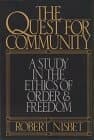
The Quest for Community: A Study in the Ethics of Order & Freedom
by Robert Nisbet
Nisbet argues that intermediate institutions—family, church, local community—are where moral formation actually happens, not in legislatures. This 1953 work offers a different angle on Geisler's project: rather than debating whether law *can* enforce morality, Nisbet asks whether law should even try, or whether it should instead protect the spaces where communities naturally transmit values. It's a sophisticated counterpoint that deepens the conversation.
View bookAbout Norman L. Geisler
N
Norman L. Geisler
Born 1932
Biography coming soon.
View author page