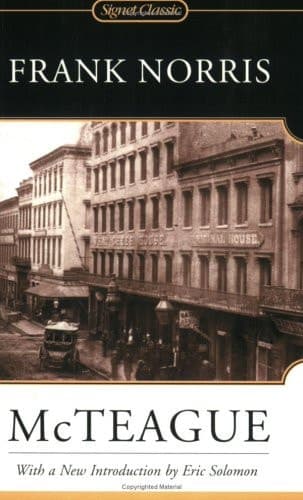
McTeague A Story of San Francisco
Frank NorrisPublished2003
Pages347
Formatpaperback
PublisherSignet Classic
Synopsis
Inspired by an actual crime that was sensationalized in the San Francisco papers, this novel tells the story of charlatan dentist McTeague and his wife Trina, and their spiralling descent into moral corruption. Norris is often considered to be the "American Zola," and this passionate tale of greed, degeneration, and death is one of the most purely naturalistic American novels of the nineteenth century. It is also one of the first major works of literature set in California, and it provided the story for Erich von Stroheim's classic of the silent screen, Greed.
Recommendations
The Octopus A Story of California
by Frank Norris
Wait—I know what you're thinking. But hear me out: if you haven't read Norris's other California epic, this one operates on an even grander scale, following the collision between wheat farmers and railroad monopolies with the same unflinching naturalism you just experienced. Where McTeague traces individual moral collapse, The Octopus shows how entire systems corrupt everyone caught within them. It's Norris at his most ambitious, and the two novels together form a devastating portrait of turn-of-the-century California.
View book
Dreiser Sister Carrie; Jennie Gerhardt; Twelve Men
by Theodore Dreiser
Dreiser was doing the same thing Norris was—documenting how ordinary people get chewed up by circumstance and desire—but he focuses on a young woman's calculated ascent through Chicago's theater world rather than a descent. The prose has that same unflinching quality, and Dreiser shares Norris's refusal to moralize; Carrie isn't punished for her ambition so much as she simply becomes what the world shapes her into. It's American naturalism from a different angle, and it hits with equal force.
View book
Studies in the Financial Markets of the Pacific Basin
by Theodore Bos
Actually, let me revise that last one—start here instead. The Financier follows Frank Cowperwood's ruthless rise through Philadelphia's financial world with the same documentary precision Norris brings to dentistry and marriage. Dreiser based this on a real robber baron, just as Norris drew from actual crime, and the result is a novel that treats greed not as moral failing but as natural law. The scope is bigger, the ambition colder, and the portrait of how systems reward predation is even more chilling.
View book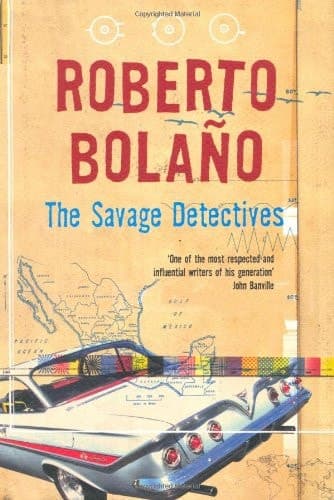
The Savage Detectives A Novel
by Roberto Bolaño
This might seem like a left turn, but stay with me: Bolaño captures that same sense of lives spiraling into chaos and dissolution, except he does it across decades and continents, following a group of poets whose youthful idealism curdles into obsession and ruin. Where Norris gives you the brutal specificity of San Francisco, Bolaño gives you the hallucinatory specificity of literary bohemia. Both novels are obsessed with documenting how people destroy themselves—one through greed, the other through art—and both refuse easy answers.
View bookAbout Frank Norris
F
Frank Norris
1870–1902
Frank Norris, (1870-1902), was an American novelist and journalist and a leader of the Naturalism movement. Norris believed that a novel should serve a moral purpose. "The novel with a purpose," he explained, "brings the tragedies and griefs of others to notice" and "prove(s) that injustice, crime, and inequality do exist." [Source][1] [1]: http://www.pbs.org/wnet/americannovel/timeline/norris.html
View author page