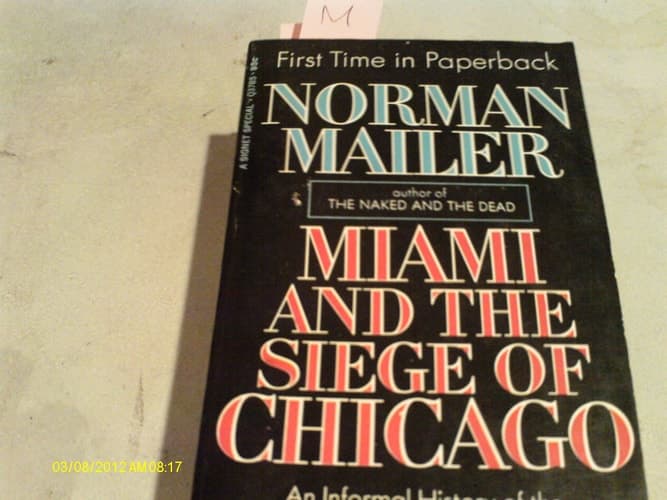
Miami and the Siege of Chicago An Informal History of the Republican and Democratic Conventions of 1968
Norman MailerPublished1986
Pages223
Formatpaperback
PublisherD.I. Fine
Synopsis
An American novelist records his reaction to the delegates, the issues, and the events of the 1968 conventions
Recommendations

The Best and the Brightest
by David Halberstam
Halberstam does for the Vietnam War and Kennedy administration what Mailer does for the '68 conventions—he's embedded in the moment, interviewing the key players and dissecting how ideology, ego, and miscalculation collide at the highest levels. Both books treat political theater as a window into American character, and both authors refuse the comfortable distance of pure journalism.
View book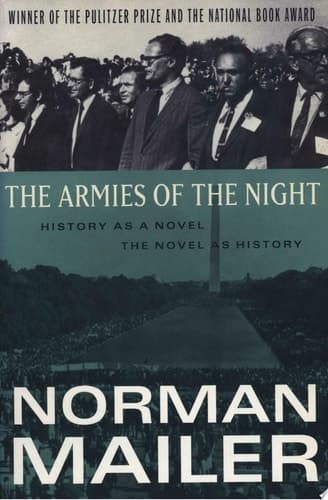
The Armies of the Night History as a Novel, the Novel as History (Pulitzer Prize and National Book Award Winner)
by Norman Mailer
Oates captures the 1967 March on the Pentagon with the same restless, digressive energy Mailer brings to Chicago—she's interested in the *texture* of protest, the individual faces and contradictions, not just the ideology. Her prose has that same quality of a brilliant mind thinking in real-time, making connections others miss.
View book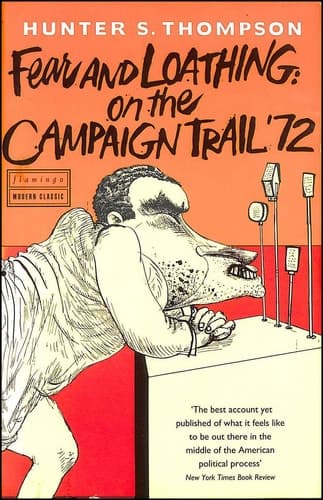
Fear and Loathing On the Campaign Trail '72
by Hunter S. Thompson
Thompson follows the 1972 election with the same gonzo intensity Mailer brings to '68, but where Mailer is the intellectual observer, Thompson is the participant-saboteur, his rage and disappointment bleeding directly onto the page. Both are asking: what does it mean to watch American democracy perform itself? But Thompson's answer is far more acidic.
View book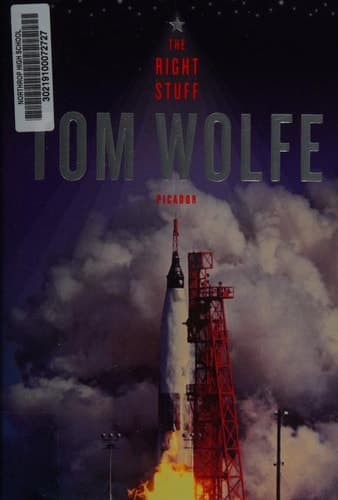
The Right Stuff
by Tom Wolfe
This is the surprise pick—it's not about politics, but Wolfe's dissection of the Mercury astronauts has the same anthropological precision Mailer uses on delegates. Both authors are fascinated by how American mythology gets constructed through individual personalities and institutional pressures, and both write with that same baroque, digressive style that makes you feel like you're inside someone's brilliant, wandering mind.
View book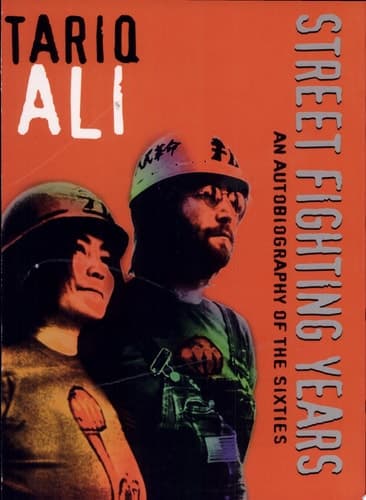
Street Fighting Years An Autobiography of the Sixties
by Tariq Ali
Gitlin was actually *in* the streets during the period Mailer was observing from the convention floor, and his memoir-history gives you the counterculture perspective that Mailer's book only glimpses from the outside. Together they create a stereo image of 1968—establishment and rebellion talking past each other, both convinced they're saving America.
View bookAbout Norman Mailer
N
Norman Mailer
1923–2007
Norman Kingsley Mailer was an American novelist, journalist, essayist, poet, playwright, screenwriter and film director. Along with Truman Capote, Joan Didion, Hunter S. Thompson, John McPhee, and Tom Wolfe, Mailer is considered an innovator of narrative nonfiction, a genre sometimes called New Journalism, which superimposes the essay onto the nonfiction novel. He was awarded the Pulitzer Prize twice and the National Book Award once. In 1955, Mailer, together with Ed Fancher and Dan Wolf, first published The Village Voice, which began as an arts and politics oriented weekly newspaper distributed in Greenwich Village. In 2005, he won the Medal for Distinguished Contribution to American Letters from the National Book Foundation. ([Source][1]) [1]: http://en.wikipedia.org/wiki/Norman_Mailer
View author page