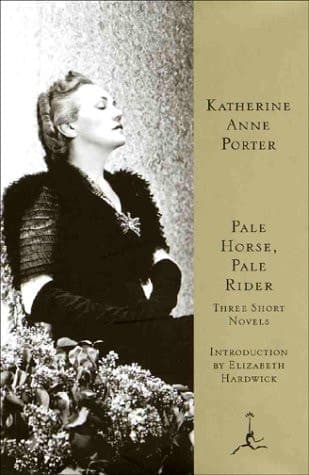
Pale Horse, Pale Rider (Modern Library)
Katherine Anne PorterPublished1998
Pages205
Formathardcover
PublisherModern Library
Synopsis
"Most good stories are about the interior of our lives, but Katherine Anne Porter's stories take place there," said Eudora Welty. "They show surface only at her choosing."
Pale Horse, Pale Rider comprises three of the Pulitzer Prize-winning author's short novels or long stories, as Porter--who didn't hold with the term "novella"--called her pieces. In the masterly "Noon Wine," set on a Texas farm circa 1900, she offers an unforgettable study of evil. According to Reynolds Price the tale "can stand shoulder to shoulder with anything in Tolstoy or Chekhov." Both "Old Mortality" and the title story center on Porter's fictional counterpart, Miranda: a resilient Southern heroine who, as Mary Gordon observed, is in "the precarious position of a woman who must earn her way with no one behind her to break her fall."
"Many of Katherine Anne Porter's stories are unsurpassed in modern fiction," said Robert Penn Warren. "Miss Porter has the power that Chekhov or Frost or Ibsen, or sometimes Pound, has, the power to make the common thing glow with an Eden-like innocence." And The Saturday Review stated, "Porter moves in the illustrious company headed by Hawthorne, Flaubert, and Henry James."
significant role in American cultural life for the better part of a century.
The series was founded in 1917 by
the publishers Boni and Liveright
and eight years later acquired by
Bennett Cerf and Donald Klopfer. It provided the foundation for their next publishing venture, Random House. The Modern Library has been a staple of the American book trade, providing readers with affordable hardbound editons of impor-tant works of literature and thought. For the Modern Library's seventy-fifth anniversary, Random House
redesigned the series, restoring
as its emblem the running torchbearer created by Lucian Bernhard
in 1925 and refurbishing jackets, bindings, and type, as well as inaugurating a new program of selecting titles. The Modern Library continues to provide the world's best books, at the best prices.--With an Introduction by Elizabeth Hardwick.
Recommendations

Paul Bowles: The Sheltering Sky, Let It Come Down, The Spider's House (LOA #134) (Library of America Paul Bowles Edition)
by Paul Bowles
Like Porter, Bowles uses landscape as a mirror for interior psychological collapse—but where Porter's Miranda navigates social constraints, his characters are literally lost in the Sahara, stripped of civilization's scaffolding. Both writers excel at that unsettling moment when external circumstances force you to confront who you actually are beneath the performance.
View book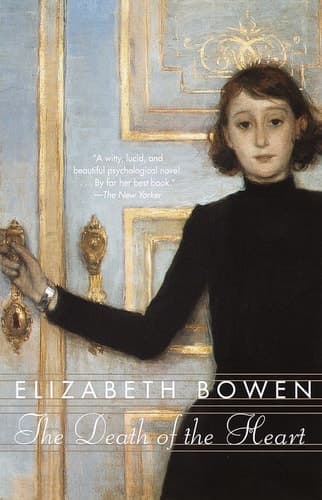
The Death of the Heart
by Elizabeth Bowen
Bowen shares Porter's gift for making domestic life feel like a minefield—her heroine Portia is another young woman navigating a world that doesn't quite protect her, and Bowen's prose has that same quality of watching carefully what people don't say. The novel unfolds with the inevitability of tragedy, but it's the small betrayals that sting.
View book
Toni Morrison - Beloved
by Carl Plasa
This is the surprise pick, but hear me out: Morrison does what Porter does with memory and trauma, except she refuses the polite distance of Porter's narrative voice. Where 'Pale Horse, Pale Rider' hints at psychological fracture through restraint, Morrison explodes it across time, showing how the past doesn't stay past. Both are unflinching about what survival costs women.
View book
The remains of the day de Kazuo Ishiguro
by Gallix/François
Ishiguro builds his entire novel on what his narrator won't admit to himself—the way Porter's Miranda pieces together the gap between what people claim and what they actually do. Both writers trust readers to feel the tragedy in restraint, in the small moments where someone almost speaks the truth but doesn't.
View book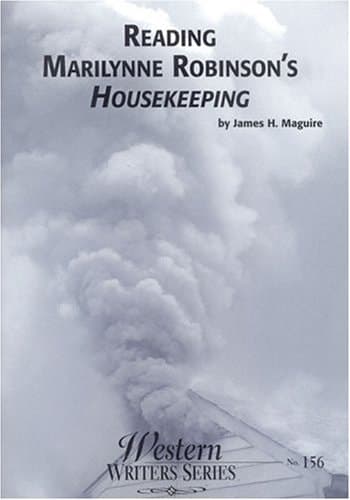
Reading Marilynne Robinson's Housekeeping (Boise State University Western Writers Series)
by James H. Maguire
Robinson writes about women adrift in American landscapes with a tenderness and moral complexity that echoes Porter, but her prose has an almost biblical cadence. Like 'Old Mortality,' this explores how women construct identity against family mythology, but Robinson sets it in the Pacific Northwest and makes the setting itself a character—lonely, beautiful, and ultimately indifferent to human need.
View bookAbout Katherine Anne Porter
K
Katherine Anne Porter
1890–1980
"Katherine Anne Porter was a Pulitzer Prize-winning American journalist, essayist, short story writer, novelist, and political activist. Her 1962 novel Ship of Fools was the best-selling novel in America that year, but her short stories received much more critical acclaim. She is known for her penetrating insight; her work deals with dark themes such as betrayal, death and the origin of human evil." - Wikipedia
View author page