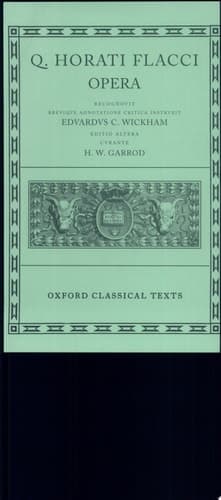
Synopsis
The Oxford Classical Texts, or Scriptorum Classicorum Bibliotheca Oxoniensis, are renowned for their reliability and presentation. The series consists of a text without commentary but with a brief apparatus criticus at the front of each page. There are now over 1 volumes, representing the greater part of classical Greek and Latin literature. The aim of the series remains that of including the works of all the principal classical authors. Although this has been largely accomplished, new volumes are still being published to fill the remaining gaps, and old editions are being revised in the light of recent research or replaced.
Recommendations
Erotica The Elegies of Propertius, The Satyricon of Petronius Arbiter, The Kisses of Johannes Secundus, and The Love Epistles of Aristænetus
by Walter K. Kelly
You've just spent time with Horace's precise, controlled verse—now try his contemporary's sprawling, chaotic prose narrative. Petronius shares Horace's satirical eye for human folly and social pretension, but he deploys it across a picaresque adventure rather than contained lyric poems, giving you that same sharp observation of Roman life but in a completely different literary form.
View book
Homer: The Odyssey
by Homer
Before Horace refined the art of the epistle and perfected the ode, Homer was establishing what it meant to write with formal precision and emotional depth in ancient Greek. Reading Homer after Horace lets you see how later poets learned from and responded to epic tradition—you'll notice how Horace's shorter forms often contain the same narrative and philosophical weight Homer spreads across thousands of lines.
View book
Poetics. English Aristotle on the art of poetry
by 384 BC Aristotle
Here's the surprise turn: Horace was deeply influenced by Aristotelian thinking about how literature works, and reading Aristotle's *Poetics* will illuminate why Horace made the formal choices he did. It's not poetry itself, but it reads like a conversation between two brilliant minds about what makes writing effective—and you'll find Horace's own *Ars Poetica* gains new resonance once you understand the philosophical framework behind it.
View book
Ovid Metamorphoses
by Ovid
Ovid was Horace's younger contemporary, and while Horace favored restraint and moral instruction, Ovid went for baroque transformation and sensual excess. Both poets were obsessed with form and structure, but where Horace's odes feel like perfectly-cut gems, Ovid's narratives are endlessly inventive shapeshifters—it's a fascinating counterpoint that shows you the range of what Roman poetry could do.
View book
The Odes of Pindar
by Pindar
Pindar wrote the victory odes that Horace admired and emulated, so reading the original source material shows you what Horace was in conversation with. Pindar's dense, allusive style and his ability to pack mythology, praise, and philosophy into tight stanzas directly influenced Horace's approach—you'll see both the continuity and how Horace made the form his own.
View bookAbout Horace
H
Horace
Born 1951
Biography coming soon.
View author page