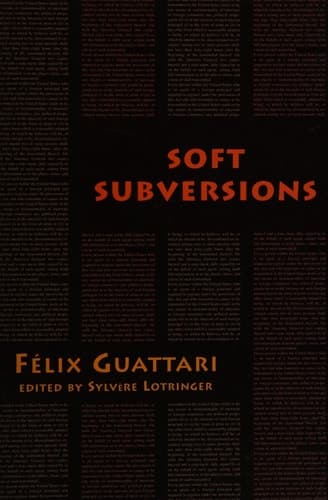
Soft Subversions (Semiotext(e) / Foreign Agents)
Félix GuattariPublished1996
Pages288
Formatpaperback
PublisherSemiotext(e)
Synopsis
This collection of Felix Guattari's essays, lectures, and interviews traces the militant anti-psychiatrist and theorist's thought and activity throughout the 1980s ("the winter years"). Concepts such as "micropolitics," "schizoanalysis," and "becoming-woman" open up new horizons for political and creative resistance in the "postmedia era."
Guattari's energetic analyses of art, cinema, youth culture, economics, and power formations introduce a radically inventive thought process engaged in liberating subjectivity from the standardizing and homogenizing processes of global capitalism.
Recommendations

A Thousand Plateaus Capitalism and Schizophrenia
by Gilles Deleuze
Since you've clearly connected with Guattari's conceptual toolkit, this collaborative masterwork with Deleuze is the natural next step—it's where 'rhizomes,' 'body without organs,' and 'deterritorialization' get their fullest elaboration. Fair warning: it's deliberately non-linear and demands active reading, but the payoff is watching these two theorists build an entire alternative logic for thinking about power, desire, and becoming.
View book
Comments on the Society of the Spectacle
by Guy Debord
Debord's 1967 polemic shares Guattari's urgency about how capitalism colonizes consciousness, but where Guattari opens doors toward creative escape routes, Debord diagnoses the total capture of authentic experience through media and commodity logic. Reading them together creates a productive tension—you'll find yourself asking whether Guattari's 'soft subversions' are genuine alternatives or just more sophisticated forms of the spectacle Debord warns about.
View book
Quilting and Braiding The Feminist Christologies of Sallie McFague and Elizabeth A. Johnson in Conversation
by Shannon Schrein
This might seem like a departure, but Kimmerer's essays about reciprocal relationships with the living world embody the kind of 'becoming-other' and resistance to capitalist homogenization that Guattari theorizes—except she grounds it in actual Indigenous practice rather than abstract philosophy. It's your surprise recommendation because it proves these radical ideas aren't just intellectual exercises; they're ways of being that cultures have sustained for millennia.
View book
Cowboy Capitalism European Myths, American Reality
by Olaf Gersemann
Fisher updates Guattari's 1980s analysis for the 2000s, arguing that we've lost even the *imagination* of alternatives to capitalism—a darker reading of the terrain Guattari was already mapping. His writing is much more accessible than Guattari's, almost conversational, but he's asking the same urgent question: how do we crack open the seemingly inevitable logic of the system? It's a perfect bridge if you want to stay in this theoretical territory but with clearer prose.
View bookAbout Félix Guattari
F
Félix Guattari
1930–1992
Pierre-Félix Guattari (April 30, 1930 – August 29, 1992) was a French psychotherapist, philosopher, semiologist, and activist. He founded both schizoanalysis and ecosophy, and is best known for his intellectual collaborations with Gilles Deleuze, most notably *Anti-Oedipus* (1972) and *A Thousand Plateaus* (1980), the two volumes of *Capitalism and Schizophrenia*. **Source**: <a href="https://en.wikipedia.org/wiki/F%C3%A9lix_Guattari">Felix Guattari</a> on Wikipedia (<a href="https://en.wikipedia.org/wiki/Wikipedia:Text_of_Creative_Commons_Attribution-ShareAlike_3.0_Unported_License">CC BY-SA 3.0</a>).
View author page