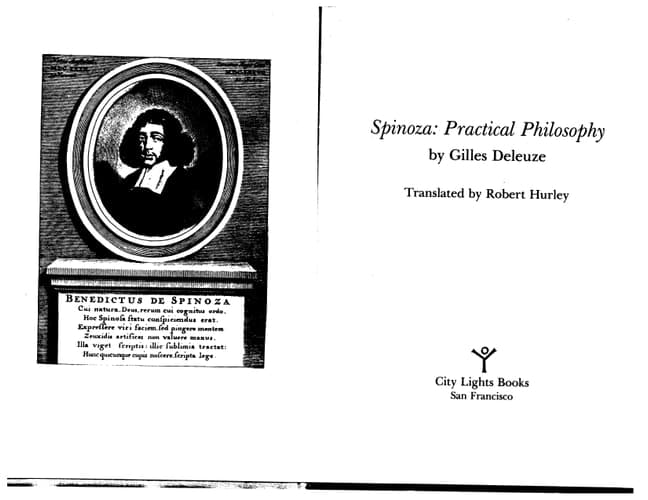
Spinoza Practical Philosophy
Gilles DeleuzePublished1988
Pages130
Formatpaperback
PublisherCity Lights Books
Synopsis
Spinoza's theoretical philosophy is one of the most radical attempts to construct a pure ontology with a single infinite substance. This book, which presents Spinoza's main ideas in dictionary form, has as its subject the opposition between ethics and morality, and the link between ethical and ontological propositions. His ethics is an ethology, rather than a moral science. Attention has been drawn to Spinoza by deep ecologists such as Arne Naess, the Norwegian philosopher; and this reading of Spinoza by Deleuze lends itself to a radical ecological ethic. As Robert Hurley says in his introduction, "Deleuze opens us to the idea that the elements of the different individuals we compose may be nonhuman within us. One wonders, finally, whether Man might be defined as a territory, a set of boundaries, a limit on existence."
Gilles Deleuze, known for his inquiries into desire, language, politics, and power, finds a kinship between Spinoza and Nietzsche. He writes, ""Spinoza did not believe in hope or even in courage; he believed only in joy and in vision . . . he more than any other gave me the feeling of a gust of air from behind each time I read him, of a witch's broom that he makes one mount.
Gilles Deleuze was a professor of philosophy at the University of Paris at Vincennes. Robert Hurley is the translator of Michel Foucault's History of Sexuality.
Recommendations
A Thousand Plateaus Capitalism and Schizophrenia
by Gilles Deleuze
Since you've engaged with Deleuze's reading of Spinoza's ontology, you're ready for the full collaborative work where these ideas explode into practice. Where Spinoza Practical Philosophy is a crystalline dictionary, Plateaus is a rhizomatic labyrinth—same philosophical DNA, but here Deleuze and Guattari show you how to actually *think* differently about desire, bodies, and becoming. The ecological implications you sensed in the Spinoza book become explicit and radical here.
View book
A Key to Whitehead's Process and Reality
by Alfred North Whitehead
Whitehead's metaphysics shares Spinoza's ambition to construct a unified ontology, but he approaches it through process rather than substance—every entity is defined by its relations and becomings, not fixed essences. If Deleuze showed you how Spinoza dissolves the human/nature boundary, Whitehead gives you the philosophical scaffolding for understanding why that boundary was always illusory. It's dense, but the payoff is a complete reorientation of how you think about existence itself.
View book
The Savage Anomaly The Power of Spinoza's Metaphysics and Politics
by Antonio Negri
Negri reads Spinoza as a revolutionary thinker whose ethics is fundamentally about power and resistance—he recovers the political bite that gets lost in purely contemplative readings. Where Deleuze emphasizes joy and vision, Negri emphasizes constituent power and the multitude. If you're curious how Spinoza's thought translates into actual political philosophy and collective action, this is the book that makes that connection explicit and urgent.
View book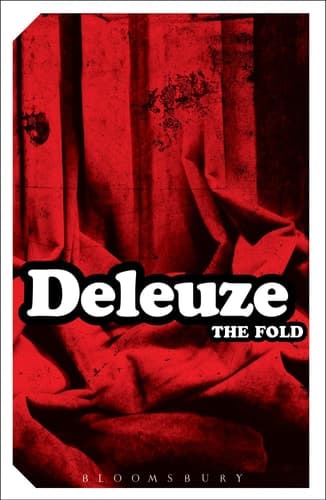
The Fold
by Gilles Deleuze
This is your surprise recommendation—it's a short, almost playful book about Leibniz that reads like a detective story about how to think about interiority and exteriority differently. Deleuze uses Baroque architecture and fabric to explore concepts that echo through Spinoza (the infinite, the fold, the inside-outside distinction), but here the philosophy becomes almost tactile. It's philosophical but feels like you're wandering through a museum rather than climbing a mountain.
View bookAbout Gilles Deleuze
Biography coming soon.
View author page